Technical analysis can help investors avoid poor performers, improving returns.
Unfavorable price action can indicate trouble ahead.
Price charts suggest these three stocks have too many headwinds.
I spend a lot of time in Smarts offering up individual stocks worth adding to portfolios, but it’s not just buying that impacts performance—the stocks you avoid also matter.
Many investors struggle to identify likely losers because CEOs can craft a compelling thesis for even the worst-performing stocks. One thing that isn’t easily sugar-coated, though, is price action.
Stock prices reflect the aggregate view of all market participants, including those managing billions of dollars who have teams of analysts crunching numbers, testing products, calling suppliers, and doing deep due diligence individual investors can’t. As a result, price action sniffs out trouble, making technical analysis a useful tool for identifying stocks undeserving of your hard-earned cash.
With thousands of stocks to choose from, the opportunity cost of buying a poor performer is high. Here are three stocks the charts suggest are worth passing on.
No. 1: Don’t play this game
Roblox (RBLX) may be a hit with the kids, but that doesn’t mean that now is the time to own the stock. The company’s revenue did grow 22% last quarter, but profit remains elusive. It lost $0.44 per share in Q1, and analysts expect losses to widen. The consensus expects a $1.92 loss per share in 2023, worsening to a $2.03 loss per share in 2024. That’s discouraging, given many companies have used last year’s weakness to get leaner, accelerating their pathway to profitability.
Real Money technician Bruce Kamich has analyzed charts for pro investors for over 40 years. He’s unimpressed with what he’s seeing in Roblox's recent trading. He writes:
“In this daily bar chart of RBLX, below, I can see that prices are testing the flat 200-day moving average line, and a close below this indicator seems likely. The On-Balance-Volume (OBV) line shows a rise from early May, but this pattern could reverse at any time. The Moving Average Convergence Divergence (MACD) oscillator has been hugging the zero line and suggests there is little in the way of "trend strength".”

How bad could it get if Roblox fails to hold its 200-day moving average? Kamich used daily and weekly point-and-figure charting to map out $34 and $21 price targets, respectively. Given how many stocks have upside rather than downside price targets, Roblox lands in the penalty box.
No. 2: Disconnect from this stock
T-Mobile (TMUS) operates in a bare-knuckle brawl industry. Wireless companies fight tooth and nail for subscribers, and the industry is mature enough that it’s tough to grow subscribers without having to steal them away.
This is evidenced by the fact that T-Mobile’s top line has fallen in each of the past four quarters, declining by 1%, 1%, 2%, and 2% in those periods, respectively. The good news is that T-Mobile remains handsomely profitable, with Wall Street estimates for $7.28 per share this year. The bad news is that outlook isn’t convincing many investors to buy shares.
Kamich writes: “In the daily bar chart of TMUS, below, I can see that the shares have turned lower and broken the lows going back to September/October. Prices trade below the declining 50-day moving average line and below the declining 200-day moving average line.
The On-Balance-Volume (OBV) line shows weakness from early April and tells me that the sellers of TMUS have been more aggressive than buyers. The Moving Average Convergence Divergence (MACD) oscillator is below the zero line but has crossed to the upside for a cover shorts buy signal.”
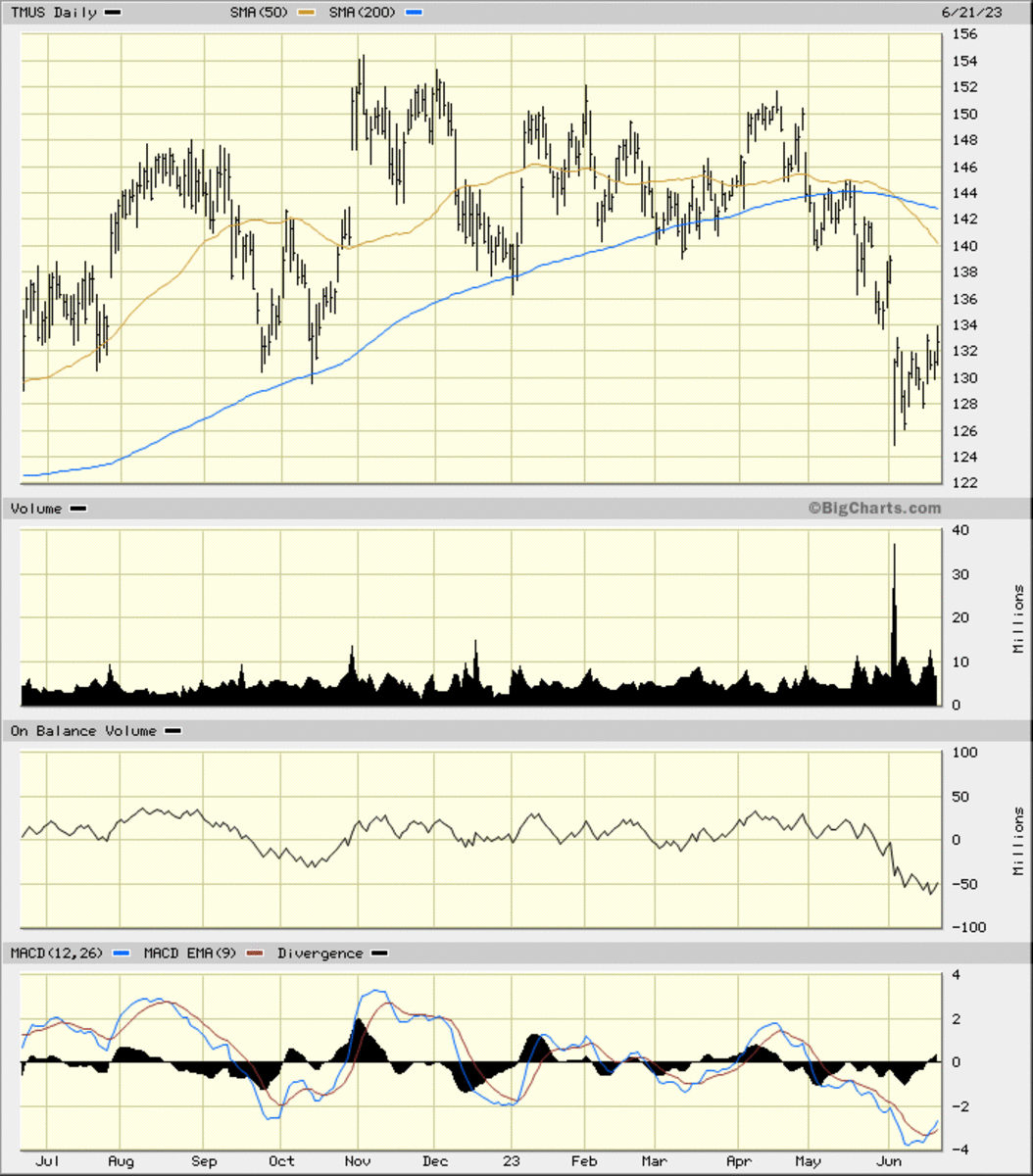
The upturn in MACD suggests you might not want to short T-Mobile’s shares, but that doesn’t mean you should rush out to buy them. Kamich’s daily and weekly point-and-figure chart price targets clock in at $101 and $98, leading him to conclude, “The charts of TMUS look bearish. Traders should avoid the long side of TMUS for now.”
No. 3: This stock still needs a jolt
The electric vehicle market undeniably offers a big opportunity for automakers. Only 14% of global car sales are electric, and that figure could climb to 40% by 2030, according to S&P Global Mobility. However, not all EV makers are created equal.
For example, Rivian’s (RIVN) electric pickup has made a splash, causing sales to skyrocket, but the company’s still trailing other carmakers in unit sales, and new competition is fast approaching.
Ford’s (F) F150 Lightning is already selling quickly. Tesla’s (TSLA) Cybertruck production is expected to begin later this year, and Chevy’s (GM) electric Silverado is on the horizon, too. Dodge is lagging behind, but it should be selling an electric truck sometime in 2024. All this competition could mean fewer orders for Rivian, slowing its progress toward profitability. That would be bad, given analysts already expect Rivian to lose $5.34 per share this year.
Kamich’s review of Rivian’s charts isn’t encouraging. He writes:
“In this daily bar chart of RIVN, below, I can see some price improvement from late April, but today I can see a large outside day. Futures traders (back in the day) viewed outside days with a lower close as bearish. Prices could retest the rising 50-day moving average line in the days ahead. Trading volume is active and the On-Balance-Volume (OBV) line remains in a downward trend. The Moving Average Convergence Divergence (MACD) oscillator is only slightly above the zero line.”
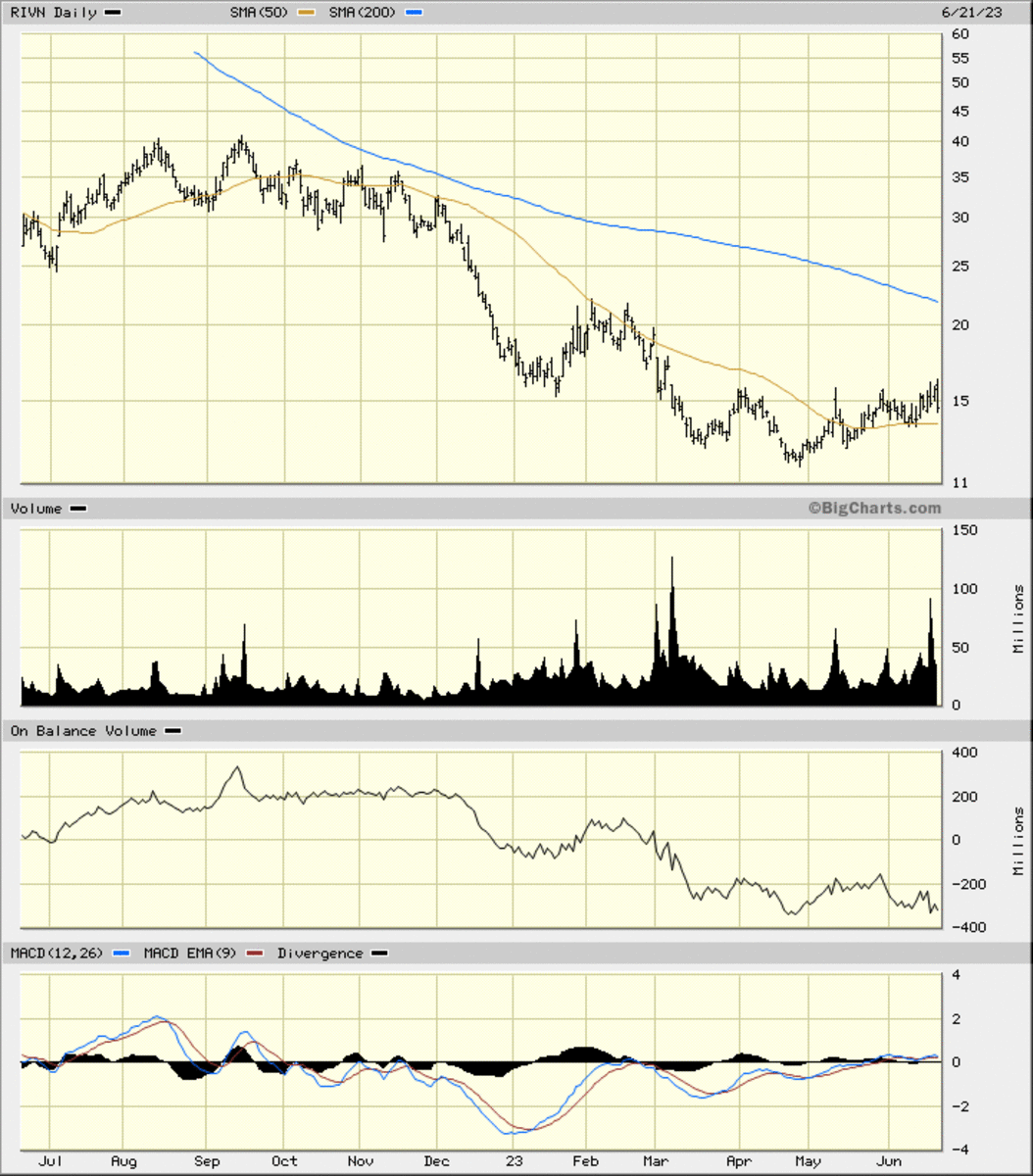
It’s not all bad news, though. Point and figure charts suggest Rivian could trade up to about $18 to $20. Nevertheless, Kamich says, “I do not find the charts and indicators of RIVN to be attractive. The path of least resistance looks to be lower. Avoid the long side of RIVN for now.”
The Smart Play
There are many choices for investors, including holding cash. Time frames matter too. Stocks can experience periods of underperformance followed by periods of excess return. One benefit of technical analysis is it helps investors decide whether the odds favor better or worse than market returns.
These stocks could re-exert, making them candidates for watch lists and portfolios. Paying attention to the charts will tell you when that time comes. Until then, it’s best to focus on other stocks without the overhang of a bearish chart.
Comments