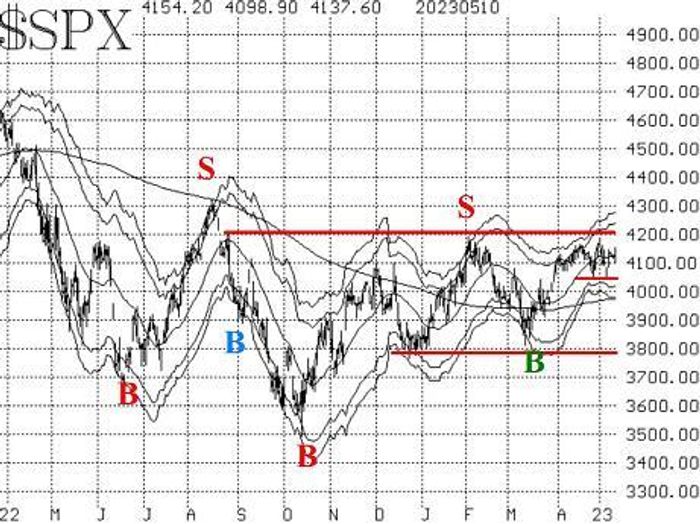
The stock market, as measured by the S&P 500 Index, has had many days that were substantially up or down, but the net result has been little change. SPX remains in the trading range that is bound by 4050 on the downside and 4200 on the upside. That is the short-term trading range which has been in place since early April.
A wider trading range has been in place for the year so far: that one also has 4200 as the upper end of the range, but the lower end is 3760-3850, which has been tested a couple of times since December. As long as these ranges persist, we are not holding a “core” position.
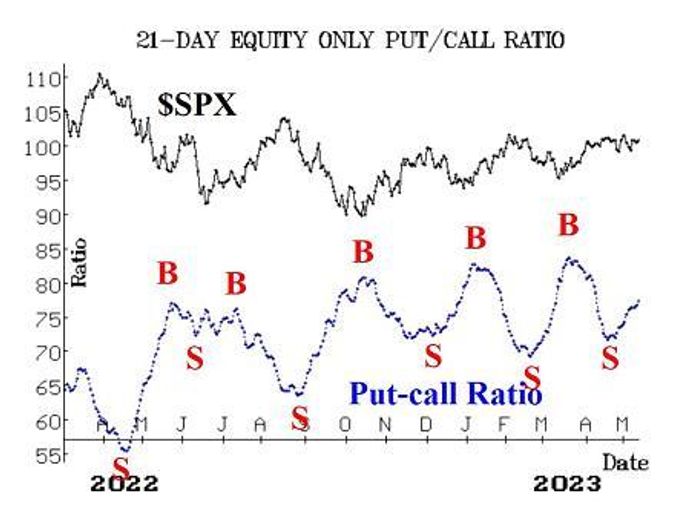
Equity-only put-call ratios continue to rise, and that is bearish for stocks. These ratios rolled over to sell signals in mid-April, and they have been in place ever since. In the past couple of days, both have moved higher, thus solidifying the sell signals.
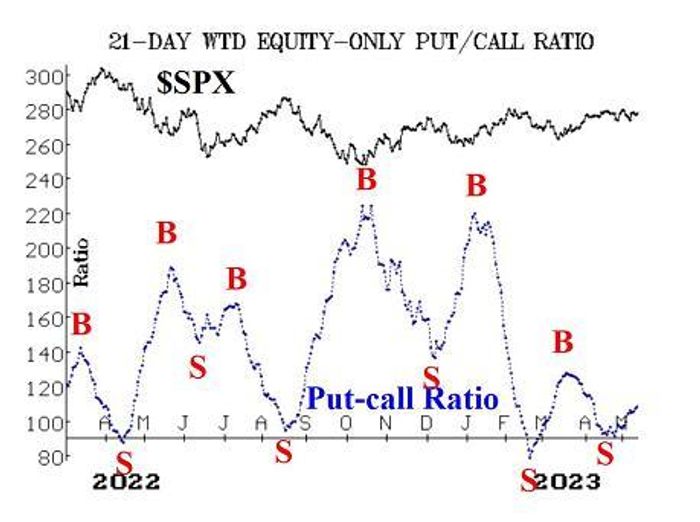
Breadth, on the other hand, has improved. Buy signals were generated from the breadth oscillators again early this week. However, given the whipsaw potential of these indicators, plus the SPX trading range, we are not taking a new position here.
New 52-week Lows on the NYSE continue to slightly outnumber New Highs on most days, so this indicator is mostly just neutral. It has no confirmed signal at this time.
VIX and the volatility complex are the most bullish indicators in our arsenal at this time. VIX generated a new “spike peak” buy signal on May 5th. It will remain in place for 22 trading days, or until stopped out by VIX closing above 21.33, its most recent high. Meanwhile, the trend of VIX buy signal remains in place and will continue to do so until VIX rises above its 200-day moving average, which is currently at 22.80 and declining.
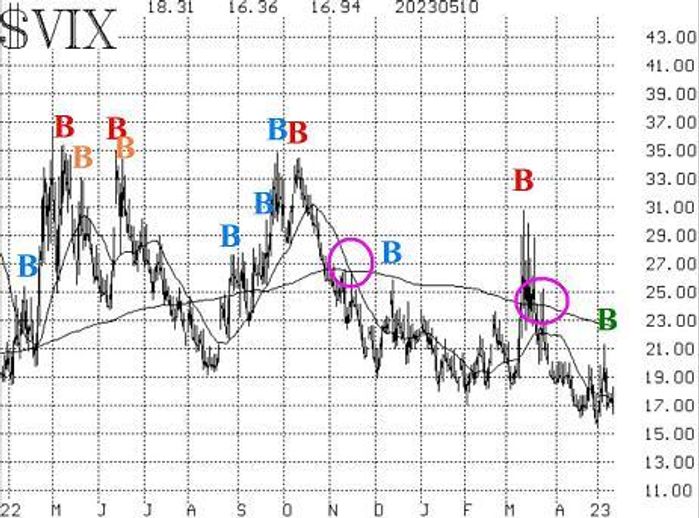
The construct of volatility derivatives remains modestly bullish for stocks. The term structure of the VIX futures slopes upward through October, and the term structure of the CBOE Volatility Indices slopes upward throughout.
In summary, we are not taking a “core” position because of the trading range nature of SPX but will trade individual indicator signals as they occur.
New recommendation: VIX ‘spike peak’ buy signal
There has been a new “spike peak” buy signal from VIX, as of May 5th. We want to add a SPY SPY, -0.13% call bull spread because of it. By the rules of the trading system that we built around these “spike peaks,” the position will remain in place for 22 trading days — about a month. It would be stopped out if VIX were to close above 21.33, which was the most recent peak on its chart.
Buy 1 SPY June (16th) at-the-money call
And Sell 1 SPY June (16th) call with a striking price 14 points higher.
Stop out of this position if VIX closes above 21.33
Follow-up action:
All stops are mental closing stops unless otherwise noted.
We are using a “standard” rolling procedure for our SPY spreads: in any vertical bull or bear spread, if the underlying hits the short strike, then roll the entire spread. That would be roll up in the case of a call bull spread, or roll down in the case of a bear put spread. Stay in the same expiration and keep the distance between the strikes the same unless otherwise instructed.
Long 1 SPY May (19th) 410 call and Short 1 SPY May (19th) 425 call: This position was bought in line with the MVB buy signal. It was rolled up 15 points on each side, when SPY traded at 410 on April 3rd. Then it was rolled out later. The target here is for SPX to trade at its +4σ Band, which is at roughly 4275. The position would be stopped out if SPX closes below the -4σ Band, which is currently near 3980.
Long 3 CARR June (16th) 42.5 puts: Close out this CARR CARR, -1.00% position, since the put-call ratio has rolled downward again.
Long 4 NDAQ Jun (16th) 55 calls: Hold these NDAQ NDAQ, -0.14% calls as along as the weighted put-call ratio is on a buy signal. It is still clinging to that buy signal currently.
Long 400 JFIN: Raise the stop on JFIN JFIN, +3.92% to 4.50.
Long 1 SPY June (16th) 409 put and Short 1 SPY June (16th) 379: This position was based on the sell signals from the equity-only put-call ratios that occurred in late April. We will hold this position until the equity-only put-call ratios roll over and begin to decline.
Long 1 SPY June (16th) 409 put and Short 1 SPY June (16th) 379: This position was based on the sell signal from realized volatility, since the 20-day Historical Volatility (HV20) of SPX has risen back above 10%. This position will be stopped out if HV20 falls back to 9% or lower; it currently is at 12%.
Long 4 BWA June (16th) 42.5 puts: Continue to hold BorgWarner BWA, -1.19%.
All stops are mental closing stops unless otherwise noted.
Comments