Next week marks the Federal Reserve's interest rate decision meeting. Due to the significantly lower-than-expected nonfarm payroll data in August and September, the focus of the Fed’s meeting will be on the magnitude of the rate cut. A 25 basis point cut is market-expected and can be understood as a hawkish cut, not necessarily positive news. A 50 basis point cut would slightly exceed market expectations, so attention should be paid to the Fed Chair’s speech to judge the path and speed of further cuts. If large-scale cuts continue, the market will likely respond enthusiastically.

How will U.S. stock indices react to the Fed meeting?
Although weak economic data puts fundamental pressure on U.S. stock indices, the considerable room for rate cuts by the Fed means the market has not yet priced in the worsening economic situation. Because the rate-cutting path remains unclear, stock index volatility is expected to be limited.
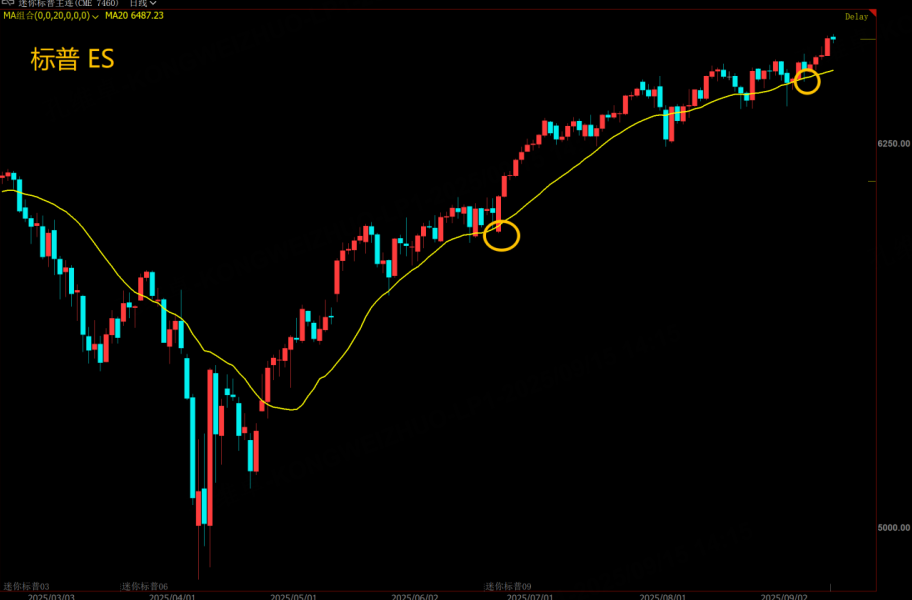
Technically, U.S. stock indices have already broken out of the previous ascending wedge pattern in an upward direction, theoretically leaving some room for further gains. Stop-loss levels should still be based on previously mentioned moving averages; no additional adjustments are needed.
Focus on U.S. soybeans ahead of China’s National Day holiday
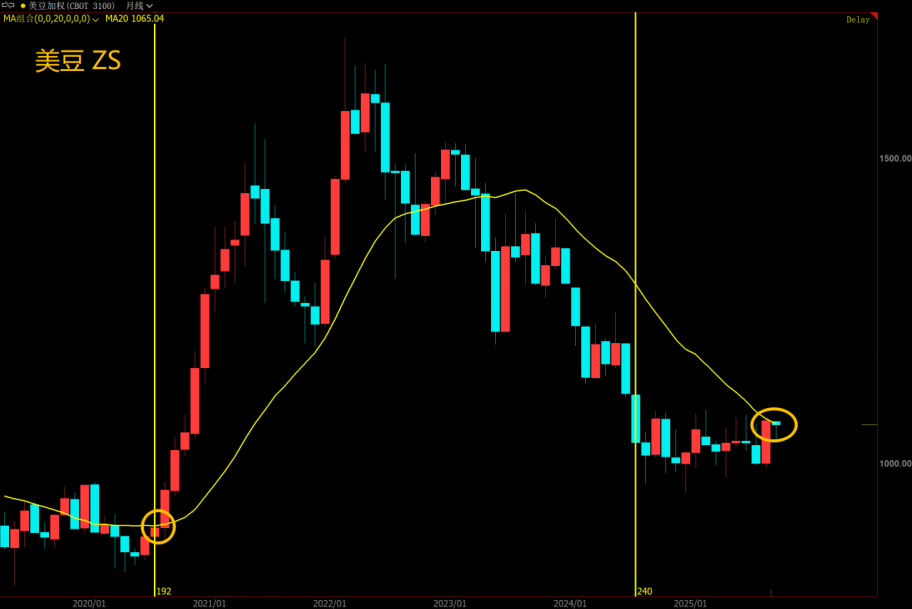
It has been a while since we discussed agriculture commodities because they have been consolidating at bottom levels, leaving little to comment on. However, last Friday night, the U.S. Department of Agriculture (USDA) released an interesting supply and demand report. This report was expectedly bearish: soybean yield was slightly increased, overall production and stocks were raised, and export forecasts were lowered. Yet, U.S. soybean prices did not drop but instead rose, showing no bearish reaction, which is intriguing.
The current timing in September is the stage where U.S. soybean production is finalized. The market’s subsequent concern is how soybeans will be sold. In the past two years, soybean prices have retreated near production costs, making selling soybeans a major concern for farmers. Consequently, around the harvest season, soybean prices often rise due to certain minor events, helping farmers to sell soybeans or hedge at higher prices.
Technically, as discussed before, the breakout near 1080 cents per bushel is a buy signal, and this remains valid. Moreover, China’s National Day holiday is approaching in about two weeks. Historically, during China’s holidays, overseas market volatility tends to increase, resulting in large fluctuations in major Chinese commodity markets after the holiday. Therefore, it is possible that soybean-related volatility will build up and erupt around China’s National Day holiday.
Strategy
The best approach is to buy call options on soybean or soybean meal futures, as options offer simple risk control and high leverage. For futures, use last week’s low as the stop-loss point; if prices fall below it, this round of price movement remains a consolidation, and it is advisable to wait for another opportunity.
$SP500指数主连 2512(ESmain)$ $道琼斯指数主连 2512(YMmain)$ $NQ100指数主连 2509(NQmain)$ $黄金主连 2512(GCmain)$ $大豆主连 2511(ZSmain)$
Comments