


Ratings agency Moody's downgraded the U.S. government's credit rating by one notch to "Aa1" from the highest "Aaa", largely due to the sharp rise in government debt over the past decade and the fact that interest payments currently account for a significantly higher proportion than countries of the same rank. Although the rating remains high, the change has caused some volatility in the market.
However, market experts believe the impact this time is much smaller than the market turmoil in 2011 when S&P first downgraded the U.S. from AAA to AA +. Back then, institutional investors were unsure how to adjust their positions in response to investment mandates, causing the stock market to react violently. Charles-Henry Monchau, chief investment officer at Syz Group, noted that "investors are more calm today because the market has experienced similar situations."
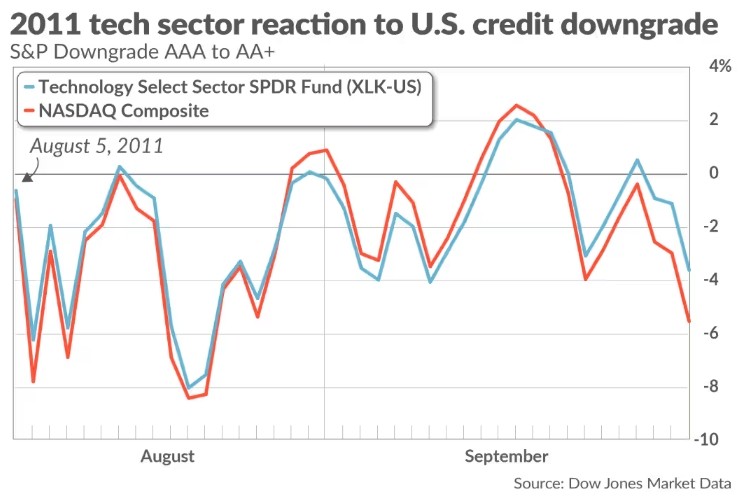
Data shows that on the first trading day of S&P's downgrade on Aug. 5, 2011, trackingS&P 500The tech sector's Technology Select Sector SPDR Fund (XLK.US) plunged 6.2%, while the tech-heavy Nasdaq tumbled 7.8%. The following month, tech stocks continued to fluctuate.
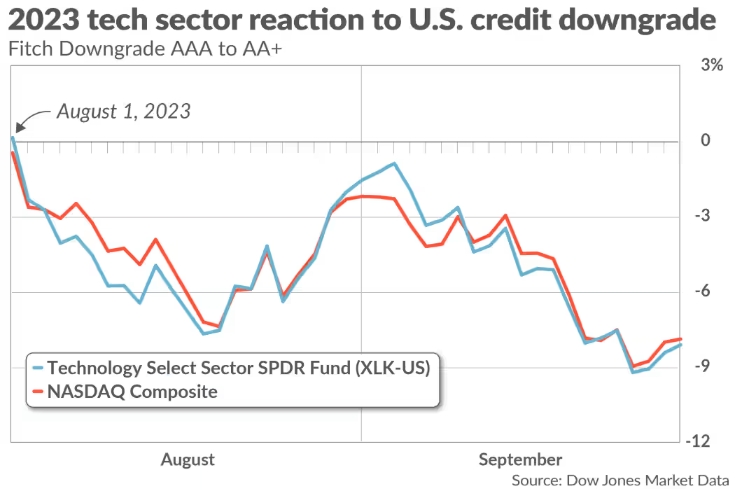
On August 1, 2023, after Fitch, another rating agency, downgraded the U.S. rating, XLK fell 2.3% the next day, with a cumulative decline of about 4% in one week; The Nasdaq fell 2.6% the next day and 3% in the week. Both rating changes have triggered significant short-term volatility in tech stocks.
In contrast, Moody's downgrade this time is not surprising. Back in November 2023, the agency had already downgraded the credit rating outlook for the U.S. from "stable" to "negative", and the market was mentally prepared. As a result, the market reaction was relatively mild following the release of the ratings last Friday.
Although the S&P 500 fell 0.9% and the Nasdaq fell 1.4% at the opening of trading on Monday, both indexes recovered their losses and gained on the day. XLK fell 0.8% in early trading on the day and also ended roughly flat.
Although the impact of this rating downgrade itself is limited, rising U.S. bond yields are the bigger risk for technology stocks. On Monday, the yield of 10-year U.S. bonds once hit 4.57%, and the yield of 30-year bonds broke through 5%, finally falling back to 4.45% and 4.91% respectively.
Higher yields mean more attractive returns on government bonds, eroding the attractiveness of high-growth assets such as tech stocks. Even if the credit rating is downgraded, government bonds are still regarded as "risk-free" assets, and annualized returns of 4.5%-5% are more attractive than technology stocks with uncertain future returns.
Despite upward pressure on yields, tech stocks are not all without bright spots. The AI boom is providing a "tailwind" for the tech sector. Large cloud computing service providers still plan to increase investment in AI infrastructure.
In addition, there are five companies in the "Big Seven" of technology giants,Amazon(AMZN.US),Googleparent company Alphabet (GOOG.US, GOOG;. US),Apple(AAPL.US), Meta (META.US), andMicrosoft(MSFT.US), delivered a bright report card in its first-quarter earnings report. Chip giantNVIDIA(NVDA.US) will also report earnings this week, and the market is highly concerned.
Investor confidence picked up even as many companies were more conservative in their financial forecasts, partly because President Trump announced a temporary cut in U.S. -China tariffs, which gave tech stocks an additional boost.
However, on the whole, the performance of the "Big Seven" is still inferior to the broader market. As of now,Roundhill Magnificent Seven ETF(MAGS.US) is still down about 3.5% during the year.
Nevertheless,Goldman SachsIn a report released on May 16, it was noted that based on the future earnings growth expectations of the Big Seven technology companies, they are on track to continue to outperform in 2025, but the excess returns may not be as significant as in past years.
