


TMT Weekly: Structural Opportunities In September!
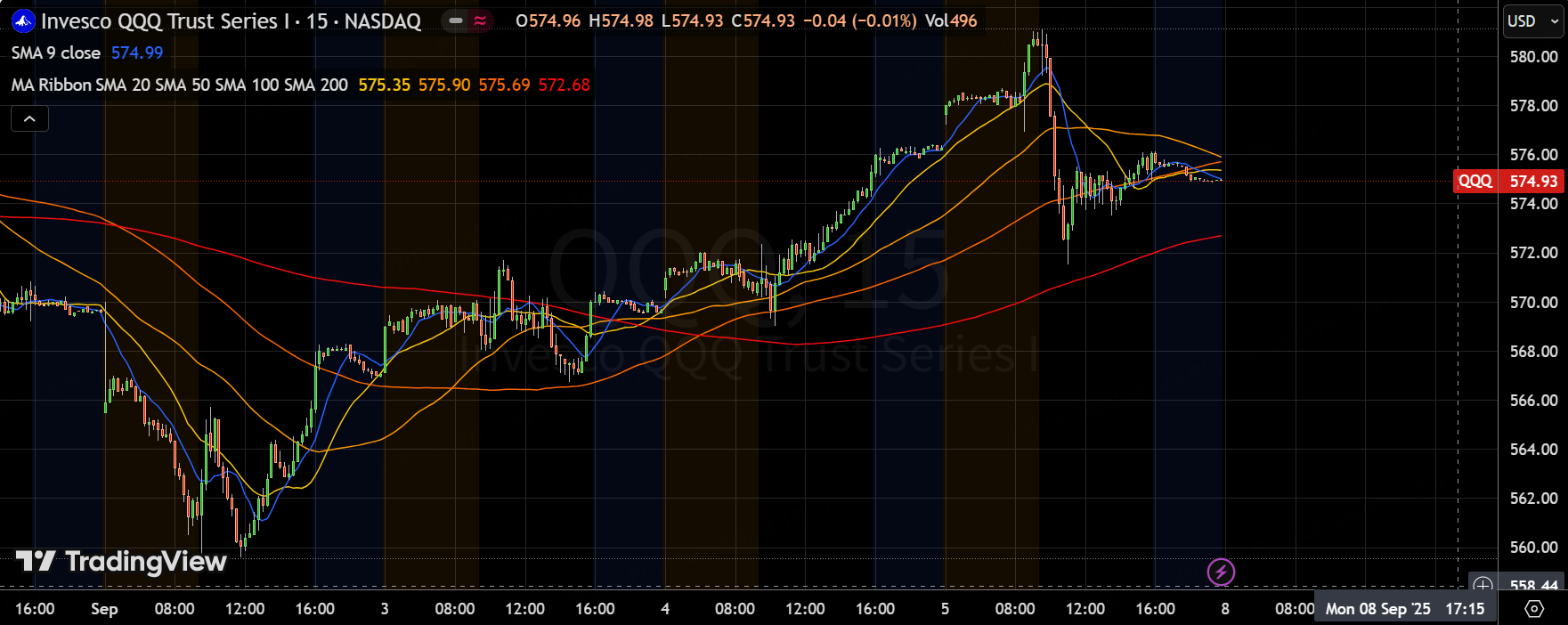
As mentioned last week, the market entered a period of overall volatility upon entering September. The first week saw the $Nasdaq 100 Index (NDX)$ still close up 1%, marking a relatively solid start to the choppy trading environment. $Nasdaq 100 ETF (QQQ)$
Divergence in TMT Stock Performance
Among the top gainers, $SanDisk Corp.(SNDK)$ surged 34.2% to lead the pack, followed by $Opendoor Technologies Inc(OPEN)$ and $Ciena Corp.(CIEN)$ followed closely with gains of 30.6% and 24.7%, respectively, while $Tianhong Technology(CLS)$ and $IOT Group(IOT.AU)$ and $Sunrun Inc.(RUN)$ also achieved gains exceeding 10%. On the downside, $Figma(FIG)$ led declines with a 16.3% drop, while $lululemon athletica(LULU)$ fell 16.2%—both facing significant negative market reactions following earnings reports. $C3.ai, Inc.(AI)$, $GroupOn(GRPN)$, $Advanced Micro Devices (AMD)$ also experienced varying degrees of pullback. The semiconductor sector fell 6.9% overall, while the media sector dropped 5.8%, becoming the primary drag on the broader market.
Network Equipment posted the strongest performance, rising 8.2% for the week with a standard deviation of 1.4; Hardware followed with a 6.4% gain, but its standard deviation reached 1.5, with $Broadcom (AVGO)$ and $NVIDIA (NVDA)$ exhibiting seesaw dynamics; $Apple (AAPL)$'s supply chain rose 4.9% with relatively low volatility and a standard deviation of 0.9. Semiconductor Equipment, Internet, and Expensive Software also delivered positive returns. Software was one of the few sub-sectors to close lower, down 0.9% for the week with a standard deviation of -0.3.
The "China Business Exposure" basket delivered a standout performance, rising 3.2% for the week with a standard deviation of 0.9. "Mega Tech Stocks" and "Profitable Long-Term Growth" posted solid gains of 3.0% and 2.3%, respectively. $Bitcoin (BTC.USD.CC)$ related assets" underperformed, falling 5.5% to become the week's laggard.
Amid an upward trend with volatility, positioning on dips is key.
The core view remains unchanged—around the time of the first rate cut, the market will continue its "volatile upward trend." If the macroeconomic landscape stays broadly stable, a strong rally is highly likely to materialize eventually. Since early August, the market has experienced six swings of 3%-5% up and down, yet the QQQ index has barely budged compared to the beginning of the month. This pattern is expected to persist for over a month.
The trading strategy is also clear: accumulate positions on dips, avoid chasing hot trends, focus on positioning during extreme market conditions, and steer clear of FOMO that leaves you missing out on both sides.
Place heavy bets on positions with favorable risk-reward ratios in the market, especially when they align with fundamental analysis. This approach allows you to seize opportunities while controlling downside risk in case of misjudgment—this instance serves as a classic example.
This week, market focus will center on PCE and CPI data. After all, following the weaker-than-expected nonfarm payrolls report, investors have already begun pricing in the possibility of three rate cuts across the Fed's final three meetings this year. The tech world also has plenty of major events: One of the year's most significant conferences, the $Goldman Sachs (GS)$ Communacopia & Tech Summit, will convene in San Francisco (schedule available via the original link); Tuesday brings Apple's new iPhone launch, $Arista Networks(ANET)$ holds its Investor Day, and $Oracle(ORCL)$, $Chewy, Inc.(CHWY)$ , $Adobe(ADBE)$ will also release earnings—another busy week packed with news.
Core Target Focus
RDDT: The Long-Term Logic Behind the Anthropic Copyright Settlement
The copyright settlement between Anthropic and authors could present a significant opportunity for $Reddit(RDDT)$ According to Bloomberg, Anthropic will pay at least $1.5 billion plus interest to resolve allegations that it "trained large language models using millions of illegally downloaded pirated books." This marks one of the largest intellectual property settlements in the AI sector to date. The class action lawsuit covers authors of approximately 7 million books. Anthropic must pay roughly $3,000 per book for 500,000 titles, with the total amount subject to increase if additional claims arise. The company is also required to destroy the data allegedly downloaded illegally.
The core point is that this signals a shift toward "paid licensed data" in both legal and commercial spheres, with Reddit holding one of the most valuable conversation datasets on the internet. More significantly, this likely foreshadows a potential reconciliation between Anthropic and Reddit, potentially leading to a licensing agreement. It's worth noting that Reddit is currently suing Anthropic, seeking to prohibit Anthropic from using Reddit data to power commercial products, halting Claude and other AI models incorporating Reddit technology, and demanding Anthropic remove all Reddit content from its systems.
We enlisted legal analyst ChatGPT to dissect the risks involved: In this author settlement case, Anthropic's legal exposure centers on "methods of data acquisition and retention," not whether "legally obtained text for training constitutes fair use." Previously, Judge Alsup in the authors' case leaned toward "lawful text training qualifying as fair use," yet permitted litigation over "unlawful acquisition/retention of data" to proceed—which is precisely the core contention in RDDT's lawsuit against Anthropic. The settlement agreement also specifies remedial measures: Anthropic must destroy pirated files and derivative copies within 30 days of the final judgment, provide proof of deletion, and the agreement does not grant authorization for future training. This indicates the court will rigorously scrutinize data sources. Should Anthropic become embroiled in another "data source dispute" like RDDT's, it will face identical scrutiny and penalties.
More importantly, Reddit's datasets are becoming increasingly vital for large language models (LLMs). According to Statista data, Reddit accounted for 40.1% of the top 10 web domains referenced by LLMs in June 2025—far surpassing Wikipedia (26.3%) and YouTube (23.5%). It has emerged as an "infrastructure-level" data source for LLM security tuning, timeliness supplementation, and conversational breadth expansion.
Based on these factors, we assess that Anthropic $Amazon.com(AMZN)$ is highly likely to settle with RDDT, potentially through a "cash + future licensing" arrangement. As early as July 3, Anthropic filed for a "stay of litigation pending mediation," a move typically preceding settlement negotiations. The mediation period generally lasts 90 days, meaning a critical window will open around early October.
If both parties reach an authorization agreement, it would serve as a major catalyst for RDDT: not only would it add another LLM client beyond existing partnerships with OpenAI and Google, but Anthropic's substantial payments would also amplify the value of RDDT's collaborations with Google and OpenAI, further cementing its position as an "LLM infrastructure" provider.
On the data front, while RDDT's U.S. daily active users (DAUs) fell slightly short of market expectations, the key is sustained month-over-month and year-over-year growth—which appears to be on track—so concerns remain manageable. The final September figures will provide further clarity. Tracking metrics within the quarter continue to improve, and with earnings season approaching, more positive feedback is highly likely. Regarding performance benchmarks, September faces significant year-over-year pressure (12 percentage points higher than last year), but this pressure eases to 3 percentage points in December and further decreases by 10 percentage points in Q1 next year. Thus, the current quarter represents the toughest hurdle; once cleared, subsequent growth will become smoother.
From a technical perspective, RDDT's stock has formed a cup-and-handle pattern. Since we turned bullish in June, it has surged 100%, yet its valuation remains attractive—trading at under 45 times 2026 earnings per share (EPS). With revenue expected to grow at a 45%-50% compound annual growth rate (CAGR) from 2025 to 2027, it offers compelling value.
The AI-driven "unit price dividend" in the advertising sector is severely underestimated.
After discussing RDDT, let's turn to the advertising sector—currently, the most promising area is AI advertising. The value of this direction remains largely underappreciated by the market. Many veteran fund managers still perceive digital advertising growth through the lens of "overall advertising market growing at 3% annually, with digital ads achieving higher growth by capturing market share, then platforms (like META) dividing the pie." However, AI is fundamentally reshaping this logic.
Taking $Meta Platforms, Inc.(META)$ as an example, the core of advertising growth lies in "impressions × cost per action (CPA)". While the market focuses on impressions (user count × usage time × ad load rate), almost no one pays attention to CPA—yet CPA is precisely where AI's power lies. Here, we must clarify a common misconception: People often equate "price per click" with CPM (cost per thousand impressions), but the actual price per click is "click-through rate (CTR) × conversion rate (CVR) × average revenue per user (ARPU)". Now, META is not only boosting CTR and CVR but also optimizing these metrics to increase ARPU, creating greater upside for price per click—this is precisely where AI (machine learning) works its magic, and real-time results are already visible.
Regarding performance expectations, META has already achieved 22% growth in Q1, with guidance pointing to a high end of 24%. However, I anticipate actual growth will be higher: Q4 could reach 28%-29% (compared to the market consensus of just 22%), and full-year growth next year may hit 22%-23% (against market expectations of 16%).
$Alphabet(GOOGL)$ follows a similar logic. Search revenue grew approximately 12% in Q2, with Q3 projected to reach 14%-15% (vs. market expectations of 11%), and Q4 further increasing to 15%-16% (vs. market expectations of 10%). Current advertising-related holdings include $RDDT, U, APP, META, and GOOGL.
Regarding GOOGL, a couple more points: The previous Department of Justice ruling was essentially a "symbolic penalty" for the company. We had reduced our position before the incident but hesitated afterward about adding back—mainly because a 22x P/E ratio based on 2026 EPS doesn't seem low, leaving only 5%-6% upside to our target price. However, market sentiment is currently strong: Search and advertising data remain robust, with growth holding steady in the low double digits. GOOGL's AI leadership is gaining broader recognition; its cloud business (GCP) keeps winning new contracts and expanding market share; crucially, the potential "external TPU (Tensor Processing Unit) sales" could become a new growth engine. Switching the valuation to 2027 could push the stock closer to $300, with minimal near-term upside resistance. Therefore, we maintain our position, though our previous position adjustments weren't optimal.
U: Channel data exceeded expectations, opening up upside potential after breaking through resistance levels.
Looking at $Unity Software Inc.(U)$ we've consistently emphasized that stronger Vector business data is needed to drive the stock price above $40. Friday finally delivered—Edgewater's research revealed that following Vector's launch, both large and small-to-medium film studios increased their user acquisition (UA) budgets by 30%-40%. Yet Unity's Q3 guidance only assumes a 10% sequential growth rate for Vector. This suggests a high probability of beating expectations in Q3. We held a small-to-medium position previously and added to it on Friday.
Additionally, channel data provided by readers indicates that Unity's GMV (gross merchandise volume) grew 8% month-over-month in August, while its advertising business expanded nearly 30%—significantly outpacing the 18% growth implied by guidance. During Thursday's Citigroup conference call, CEO Bromberg delivered an upbeat outlook, noting Unity plans to expand Vector beyond its core ad network into app discovery and distribution, with e-commerce advertising potentially emerging as the next growth driver. Current market expectations for Unity's performance appear significantly understated, leaving room for upward revisions.
The technical picture is equally strong. While $42 was originally a key resistance level, U shares easily broke through this mark on Friday amid increased trading volume. As long as the stock can hold above $42, the path to $60 becomes clear, with potential to even challenge the 2021 all-time high of $200. Additionally, the CFO is scheduled to appear at the Goldman Sachs conference on Monday morning, where he may deliver further positive signals—something worth keeping an eye on.
APP joins the S&P 500 + e-commerce self-service advertising, boosted by dual catalysts
$AppLovin Corporation(APP)$ received a significant boost on Friday—its inclusion in the $SPDR S&P 500 ETF Trust(SPY)$ index, a long-awaited market milestone. However, the bigger catalyst for APP is the upcoming launch of its "self-service e-commerce advertising platform" within the next three months. Management received overwhelmingly positive feedback during this week's roadshow (we tracked sell-side notes throughout the week). Regarding competition with Unity, executives explicitly stated it's "not a zero-sum game"—as the advertising model optimizes, the entire sector has ample room for growth, allowing both APP and competitors to capture market share. Citigroup also noted on Friday that APP will provide 50 referral codes to each agency, accelerating the rollout of its e-commerce advertising business.
Two additional details warrant attention: First, FundaAl data indicates the app has prepared 300-400 referral codes for October 1st, with approximately 600 e-commerce clients already initiating campaigns. Business volume is expected to surge significantly after October. Second, the "cost-effectiveness logic" of ad placement: If a user views 10 AppLovin ads daily, 5 might come from the same game company (concentrated game company placements). However, the CPM for these 5 ads decreases incrementally (e.g., 200→150→120→100→80). Replacing just one with an e-commerce ad can immediately restore the CPM to 200. This "structural optimization" will continuously boost the app's advertising revenue.
From a technical perspective, we anticipate the APP will consolidate around the $525 level for a period. This consolidation will allow profit-taking to be absorbed while providing us with an opportunity to add to our positions. Subsequent attempts to break new highs will be more stable.
Software sector sentiment rebounds amid seasonal peak demand, with vertical SaaS emerging as a "safe haven."
After undergoing a "washout" in August, the market is now steadily rebounding, led by infrastructure stocks such as $Snowflake(SNOW)$ and $MongoDB Inc.(MDB)$, along with vertical players like $Samsara, Inc.(IOT)$ and $ServiceTitan(TTAN)$, and $Autodesk(ADSK)$—all of which recently delivered earnings that exceeded expectations.
Here are two CIO surveys from Bernstein and JPMorgan that clearly illustrate industry trends: Bernstein's survey reveals that "application software" ranks second on CIOs' spending lists. Moreover, most CIOs prefer "purchasing off-the-shelf AI solutions" rather than developing their own, and are more inclined to source AI products from existing software vendors (as AI startups lack enterprise-grade functionality and security assurances).
JPMorgan's survey countered the notion that "the software industry will disappear"—when they asked CIOs whether "AI and rapid coding would commoditize traditional software," the responses were overwhelmingly consistent:
Not at all. Anyone can handle simple A-to-B data migration applications, but expecting to effortlessly manage a system supporting BMW's transcontinental production lines and supply chain is simply unrealistic.
The gap is significant. Small and medium-sized businesses (SMBs/SMEs) are likely to be affected—for instance, the basic ERP tools used by small enterprises might be handled by AI through Excel templates, but the needs of large corporations are entirely different.
This won't happen in the next 6 to 8 years. Enterprise-level applications require hundreds of person-years of requirements analysis and feature development. Generative AI can accelerate the coding of new applications, but it won't threaten the position of existing large-scale enterprise applications.
The "doomsday theory" for the software industry is premature. Enterprise solutions like SAP and Salesforce, characterized by "high integration and deep functionality," are not one-trick-pony products. They have accumulated years of industry knowledge and capabilities. Even if AI can automate programming, replicating these functionalities would take years. However, "single-function plugins" do indeed pose risks.
Based on this feedback, we are prioritizing allocations to $Cloudflare, Inc.(NET)$, MDB, $Snowflake(SNOW)$ ORCL, and MSFT. Simultaneously, consider allocating a small position to high-quality application software companies like NOW and SAP—their valuations align well with their growth potential.
Additionally, seasonal opportunities warrant attention: October and November are the two strongest months for the software sector annually. Historical data shows that in November 2024, the sector gained 14.79%, with December also posting a positive return of 4.43%; in October 2023, it rose 5.21%, followed by a 10.86% increase in November; October 2021 saw an even more significant 10% increase—this seasonal dividend during this period is worth capitalizing on (Data source: Monthly performance table for the software sector in the original text).
Vertical SaaS: No "seat risk" + AI empowerment, becoming a "safety cushion" in volatile markets
Within the software sector, vertical SaaS represents our most promising niche focus—its core logic being "seat risk-free + AI-driven deep empowerment." In the current macroeconomic climate of uncertainty, it stands as a veritable "safe haven."
First, let's clarify "seat risk": Many application software revenues are tied to "user seat counts." AI may reduce a company's seat requirements, thereby impacting revenue. However, vertical SaaS operates differently—its revenue is linked to "physical capacity," "compliance processes," and "transaction volume." AI not only avoids reducing demand but also boosts ARPU (average revenue per user) by enhancing efficiency, increases customer retention, and even expands the total addressable market (TAM).
ChatGPT5 provides a thorough breakdown of the AI logic behind vertical SaaS: Vertical SaaS vendors hold "high-fidelity, industry-specific" process data, often serving as the "operating system for daily operations" within a given industry. When they integrate AI—especially by combining real-time data from physical devices (like POS terminals, cameras, scanners) or embedding fintech capabilities (payments, lending, insurance)—their original "recording systems" evolve into "intelligent systems" or even "transaction systems." This ultimately enables "automation of repetitive tasks," "precision in predictive recommendations," and "low-cost delivery of high-margin modules." Consequently, it drives ARPU growth, enhances pricing power, reduces customer churn, and expands the total addressable market (TAM).
Here are a few examples:
$Guidewire Software (GWRE)$ Revenue is tied to insurers' "Directly Written Premium (DWP)" rather than headcount. The recently disclosed pricing model is "based on the amount of Directly Written Premium," perfectly mitigating seat risk;
$Procore Technologies (PCOR)$ features "unlimited users," with pricing tied to project/company scale;
$Samsara, Inc. (IOT)$ Allow customers to select plans based on "number of vehicles/assets";
TOST (Toast): Charges based on "number of stores/terminals" while also generating revenue through payment services—both models are tied to "business activity volume" rather than "backend seat count."
Moreover, vertical SaaS vendors possess "years of accumulated, labeled, and authorized operational data"—a barrier that AI startups struggle to replicate. This data advantage further amplifies the impact of AI-driven capabilities.
GWRE: Insurance IT Leader, Promising High Growth and High Margins
First, let's look at GWRE. Its recent quarterly results exceeded expectations, not only achieving over 20% full-load ARR (Annual Recurring Revenue) growth but also setting the stage for further upside in its guidance. Management raised its FY26 ARR growth guidance to 16-17%, while operating margins and free cash flow margins are expected to exceed 20%. Notably, this projection is based on the conservative assumption of reduced DWP and CPI adjustment activities among on-premises clients. Management explicitly stated that "customer modernization demand has surpassed the short-term impact of DWP fluctuations," underscoring robust demand resilience.
Two additional highlights stand out: First, the 10-year partnership with Liberty Mutual represents an industry milestone, likely paving the way for more substantial deals in the future. Second, activity on the Guidewire Cloud Platform (GWCP) has recently surged significantly, potentially signaling accelerated ARR growth—as GWCP scales and implementation costs decrease, profit margins are poised to rise further.
In terms of valuation, based on a share price of $300 and an 8-year DCF model: assuming a 17% CAGR for ARR, a terminal EBIT margin of 40% (above the 30% median for mature vertical SaaS companies), and a terminal cash flow multiple of 35x (approximately 2.0x PEG), the valuation is reasonable. Moreover, during periods of macroeconomic volatility, GWRE's status as an "essential insurance IT solution" will attract greater capital interest.
ADSK: Design Software Leader Poised for AI-Driven Growth and Undervaluation Rebound
ADSK is a core target recently re-evaluated. An Investor Day will be held in early October. The current rationale is very clear:
Management credibility restoration: Achieving "performance exceeding expectations + upward guidance revisions" for multiple consecutive quarters. H2 guidance deliberately incorporates conservative assumptions like "pandemic-level headwinds," leaving ample room for continued outperformance.
Sustained Growth with a Solid Foundation: The recently disclosed FY29 profit margin targets establish a "floor" for EPS/FCF growth over the coming years. Achieving at least 15% annual growth is readily attainable, with potential for exceeding expectations should end-market conditions improve.
Low AI Risk: The design industry features slow iteration cycles and high switching costs. ADSK's "data moat" and "full-stack platform" can withstand AI disruption. The company already possesses industry-leading AI tools, with more AI functionalities likely to be unveiled at the October Investor Day. Accelerated implementation is expected next year.
Valuation remains attractive: Even after a recent 11% gain, the stock trades at just 26 times 2026 EV/FCF (Enterprise Value/Free Cash Flow). This represents exceptional value for a company characterized by high quality, over 15% compound EPS/FCF growth, a recovering end market, and an AI narrative yet to fully unfold.
ADSK's stock price remained depressed for an extended period due to factors such as "PTC acquisition rumors (denied by management), weak terminal market demand, CFO transition, and activist shareholder interference." However, these disruptive elements are now subsiding, and the narrative is becoming increasingly clear. From my perspective, the stock is currently undervalued by the market, with a high probability of steady, incremental gains moving forward. The rating can be assigned as B/B+. The technical picture also looks favorable. The stock is forming a multi-year bottoming pattern, and a breakout would open up significant upside potential.
Other promising targets: From construction to retail, vertical opportunities abound.
Beyond GWRE and ADSK, several vertical SaaS targets are worth exploring:
Construction Sector: PCOR leverages AI to automatically generate RFIs (Requests for Information)/submission documents, predict schedule delays, and streamline progress billing, advancing toward a "construction site operating system"; ADSK and BSY (Bentley Systems) utilize "generative design," "collision detection," and "digital twin analysis" to shorten design cycles and reduce rework; TRMB (Trimble) integrates GNSS/optical hardware to achieve "vision + sensor-driven automation" in construction and agriculture.
Logistics sector: DSGX (Descartes Systems Group) can leverage network data to optimize ETA (Estimated Time of Arrival) forecasting, exception handling, and carrier selection;
Retail/Food Service Sector: TOST leverages AI for "menu design," "staffing forecasting," and "fraud detection," boosting ARPU through high-margin modules while POS terminals continuously feed data. PAR Technology's "hardware + SaaS + payment" model mirrors TOST's approach, with AI optimizing inventory counting, restocking, and dynamic pricing.
Public Sector: TYL (Tyler Technologies) AI can be used for "permit approvals," "court scheduling/transcription," and "311 request classification," and can also process fines and fees with integrated payment functionality.
Life Sciences Sector: VEEV's (Veeva) "Vault documentation" and CRM data can support "content generation," "quality documentation," and "trial site selection"—all of which possess "vertical data barriers + AI-enabled potential." These targets warrant ongoing monitoring.
NET (Cloudflare): The Optimal Platform for AI-Native Growth
$Cloudflare, Inc.(NET)$ remains the top pick for "positioning for AI-native growth," especially as its recent stock performance has shown relative strength compared to this year's software standouts like MSFT, ORCL, and PLTR, making the rationale even clearer. A recent interview with NET CEO Matthew Prince by Stratechery further validates our perspective. Here are several key takeaways:
AI Agent Development: "When building AI agents today, Cloudflare Workers is the optimal choice—it enables rapid deployment and termination, connects to a global network, and ultimately routes all these agents through our network (after all, we cover most of the internet). While we may not be suited for running systems like SAP HANA, we are undoubtedly the best platform for AI agents interacting with the internet."
Data acquisition difficulty escalates: "Over the past decade, the difficulty of obtaining equivalent content clicks on Google has increased tenfold; on OpenAI, this difficulty is 750 times greater; on Anthropic, it soars to 30,000 times—underscoring the value of efficient data acquisition."
Content creator revenue sharing: "One conceivable model is for AI companies to pay $1 per monthly active user (MAU) annually, with the pooled funds distributed to content creators. Based on current scale, this would amount to roughly $10 billion—sufficient to replace all advertising revenue from non-closed-loop internet platforms."
Data Policy: "We have prohibited the use of data for Gemini training, but have not prohibited RAG (retrieval-augmented generation) and search (including Perplexity search)—this protects data copyright while not hindering fair use."
Competitive Advantage: "The 'database mindset' of hyperscalers differs from our 'network mindset'—databases prioritize 'data retention,' while networks emphasize 'rapid data transmission.' Consequently, their network products fall short, and our database offerings cannot match theirs. However, in domains like AI agents and data transmission, our advantages are pronounced."
Product Logic: "We don't create '100-page business cases.' Cloudflare Workers was developed purely to address our own needs and has since become our fastest-growing business. Domain registration, VPN alternatives, and developer platforms all started as solutions to internal challenges and eventually evolved into key product lines. This 'demand-driven' product philosophy ensures we remain at the forefront of customer needs."
These perspectives underscore NET's foundational role in the AI-native era, with strong certainty for future growth.
Valuation Opportunities Following MSFT's Pullback
$Microsoft(MSFT)$ has recently underperformed other tech stocks, likely due to "rotation of capital" similar to NVDA's situation. We've been seeking MSFT's "risk-reward sweet spot," and $475 appears to be a favorable entry point—representing a 28x P/E ratio based on 2026 EPS of $17. Since 2020, MSFT has rarely traded below a 28x P/E ratio outside of market corrections (Source: MSFT P/E ratio chart in original text).
If the stock price reaches $475, a 25% upside potential could take it to $600 (corresponding to a 2027 EPS of $20 and a P/E ratio of 30x). Therefore, MSFT trading below $500 already offers a compelling valuation, and one might even consider selling $475 puts to enhance returns.
Disclaimer: Investing carries risk. This is not financial advice. The above content should not be regarded as an offer, recommendation, or solicitation on acquiring or disposing of any financial products, any associated discussions, comments, or posts by author or other users should not be considered as such either. It is solely for general information purpose only, which does not consider your own investment objectives, financial situations or needs. TTM assumes no responsibility or warranty for the accuracy and completeness of the information, investors should do their own research and may seek professional advice before investing.
- BerniceCarter·2025-09-08Interesting analysisLikeReport