


JD.com's Q3 performance is approaching, how can short options get on the bus?
$JD.com (JD) $Third quarter results are scheduled to be announced before the market opens today.
According to the consensus estimate of 11 analysts surveyed by FactSet, third-quarter revenue is expected to increase 13% year-over-year to 294.45 billion yuan, and net profit is expected to decline 75.5% year-over-year to 2.87 billion yuan, equivalent to $402.9 million.
Looking back at the previous quarter, JD.com achieved revenue of 356.7 billion yuan last quarter, a year-on-year increase of 22.4%, the fastest growth rate since the fourth quarter of 2011. However, profitability came under significant pressure: net profit attributable to common shareholders fell 50.8% to 6.2 billion yuan, reversing the previous upward trend.
According to a research report by Jefferies analysts, thanks to the scalability of the business model and the strengthening of supply chain advantages, JD Retail is expected to grow steadily by about 16.7%. Its advantages in the field of electronics products will still benefit from government consumption subsidy policies. Analysts expect JD Retail's third-quarter operating profit to increase by about 16% year-on-year to 13.5 billion yuan, and the operating profit margin of its business unit is expected to increase by 0.3 percentage points year-on-year to about 5.5%.
Citi said that JD.COM's overall profit may drop sharply, mainly due to the company's heavy investment in food delivery and other new businesses. Analysts expect the loss of the new business segment to be slightly higher than its previous forecast of 14.2 billion yuan, which reflects the company's increased investment in international business and low-priced e-commerce platform "Jingxi"; However, the loss of the food delivery business may be flat or slightly lower than last quarter.
Highlights of Third Quarter Results Call
The trajectory of the food delivery business, and whether management will reveal the possibility of becoming profitable in 2026;
Whether the company has proposed countermeasures for the decline in net profit and free cash flow;
The latest data from the Double Eleven shopping festival, and the sustainability of the profit margin of the core retail business amid fierce competition;
The actual impact of China's stimulus policies on consumer demand;
The latest developments in the international expansion strategy, in particular the follow-up plan to acquire German e-tailer Ceconomy;
Management's comments and guidance on the Overall FY2025 Outlook.
Bear Market Call Spread Strategy
1. Strategy structure
Investors build aBear Call Spread Bear Call SpreadOption portfolio, containing two Call options (Calls) with the same expiration date:
Sell lower strike Call option (Call): K ₁ = $35, premium income $0.13;
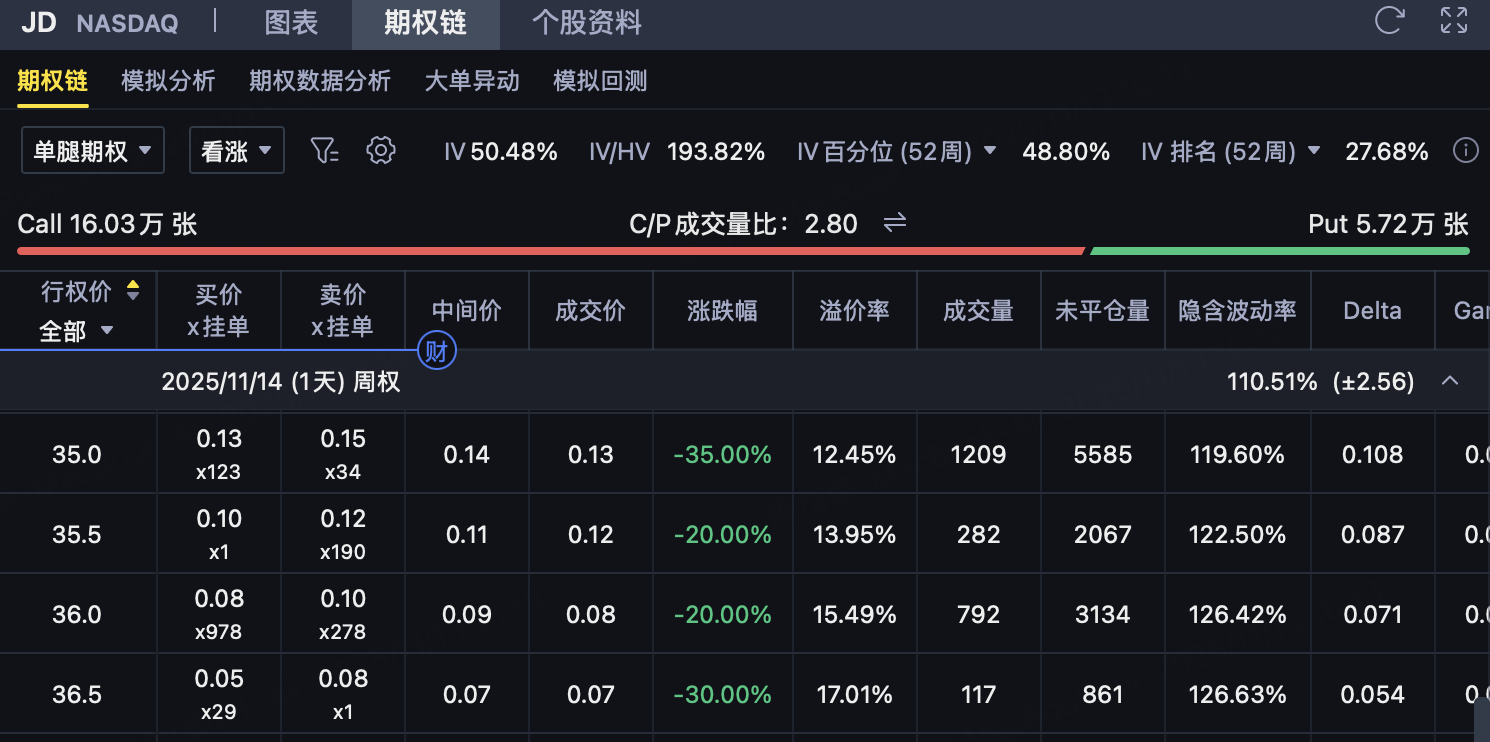
Buy a higher strike Call option (Call): K ₂ = $38, premium spends $0.04.
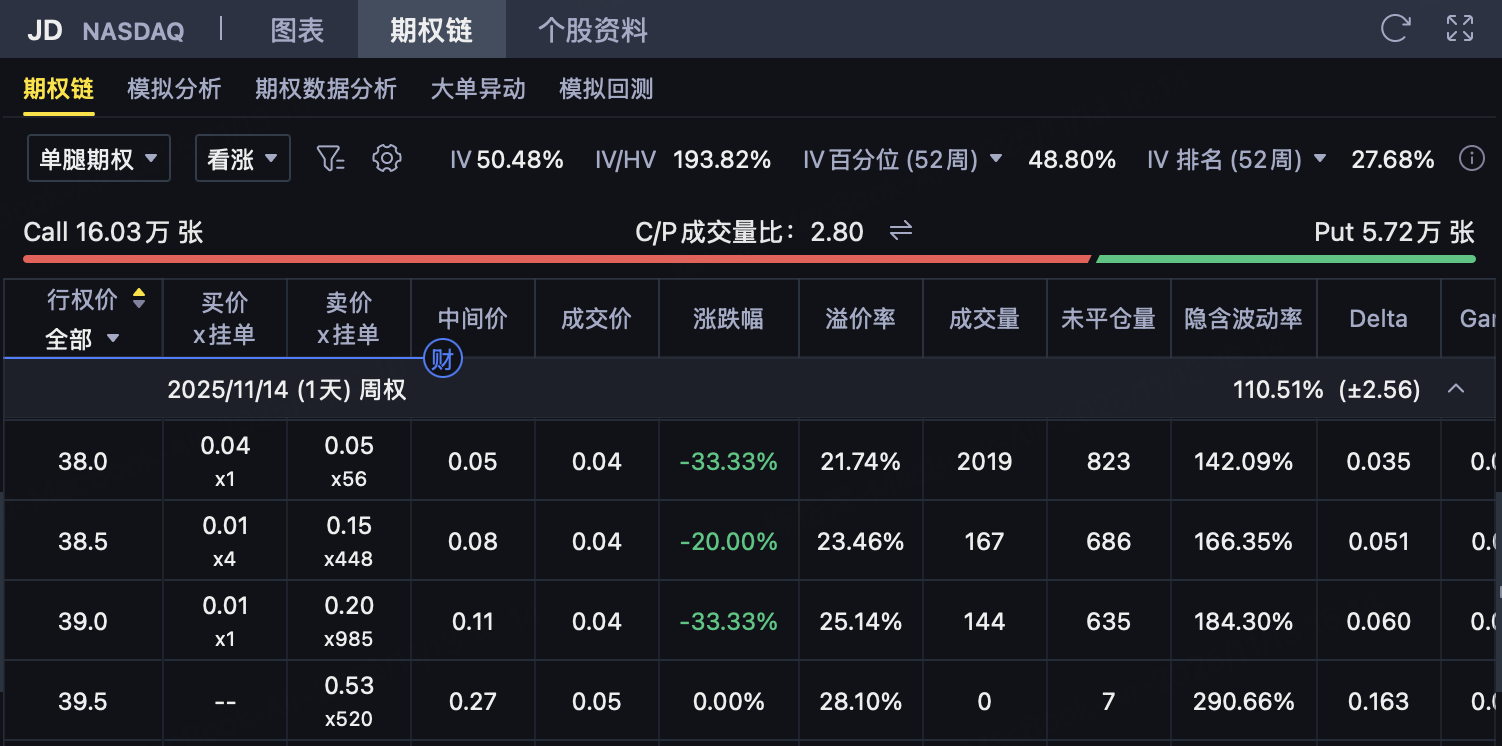
Investors build strategies by selling low strike Call and buying high strike Call. The portfolio is at the underlying asset priceMaintain at or below $35The greatest return, belonging toBearish bias, limited risk, limited benefitsStrategy.
2. Initial net income
Net premium revenue = revenue from selling Call − expense from buying Call = 0.13 − 0.04 =$0.09/share。
Corresponding total revenue = 0.09 × 100 =$9/contract。 This amount is the maximum potential profit for an investor when opening a position.
3. Maximum profit
If the underlying price at expiration is ≤ $35, neither call option will be exercised, and the investor retains all net premium.
Maximum profit = $0.09/share
Corresponding total profit = $9/contract
4. Maximum loss
If the underlying price at expiration is ≥ $38, both Calls will be exercised, and investors will suffer the maximum loss within the spread range.
Spread = 38 − 35 = $3
Maximum Loss = Spread − Net Income = 3 − 0.09 =$2.91/Share
Corresponding total loss = 2.91 × 100 =$291/contract
5. Break-even point
Breakeven point = lower strike price + net income = 35 + 0.09 =$35.09。
Hence:
When the underlying price is ≤ $35.09, investors make a profit;
When the underlying price is > $35.09, investors start losing money.
6. Risk and return characteristics
Maximum gain: $9/contract;
Maximum loss: $291/contract;
Profit/loss ratio: about 1: 32;
Applicable scenario: Investors expect the underlying price to beDown or maintained below $35;
Strategy positioning:A bearish strategy with limited returns and limited risk, suitable for investors who are conservative about price upside.
Engage and Win Options Rewards!
Share your thoughts on options trading or the market in the comments below.
10 lucky participants will each receive a free copy of the Options Handbook!
Already have one, you’ll get a USD 5 Options Voucher instead!
The Options Handbook takes you from the fundamentals to advanced strategies, helping you gradually build your own trading system. You’ll also gain insights from 10 top traders, and learn how to avoid common options trading pitfalls — making your decisions clearer.
💬 Don’t miss out, drop your thoughts and win your reward!
Disclaimer: Investing carries risk. This is not financial advice. The above content should not be regarded as an offer, recommendation, or solicitation on acquiring or disposing of any financial products, any associated discussions, comments, or posts by author or other users should not be considered as such either. It is solely for general information purpose only, which does not consider your own investment objectives, financial situations or needs. TTM assumes no responsibility or warranty for the accuracy and completeness of the information, investors should do their own research and may seek professional advice before investing.
- AuntieAaA·2025-11-14GoodLikeReport