


Use an iron eagle strategy to deal with the downturn
Near the end of the year, the U.S. stock market has gradually entered the rhythm of holiday trading, the activity of institutional funds has declined, and the overall trading volume has continued to decline. Indexes and individual stocks have generally shown a narrow range of fluctuations, and directional opportunities have been significantly reduced. In an environment of weak liquidity and limited volatility, the winning rate of simply betting on rising or falling decreases, while the option strategy with "range judgment" as the core has more advantages. Based on the current market characteristics of light transactions in U.S. stocks at the end of the year and the lack of trend in stock prices, investors can consider$Google (GOOG) $On options, a selling iron eagle strategy is constructed. By collecting premium within a reasonable shock range, the low-volatility environment is transformed into a stable source of income on the premise of controlling the maximum risk.
Google Sell Iron Eagle Options Strategy
1. Strategy structure
Investors build a Short Iron Condor strategy on Google (GOOG) options.
This strategy is a combination of a set of Put Call spreads and a set of Call Put spreads on the same expiration date. The core goal is to collect premium at one time. It is suitable for investors to judge that GOOG has a high probability of maintaining range shocks before the expiration date. There is an obvious unilateral breakthrough.
(1) Put end (bullish spread, bullish)
Sell Put with a higher strike price: Investors sell Put with a strike price of K ₂ = 305 and charge premium $1.51. This option is closer to the current stock price and is the main source of premium on the Put side.
Buy Lower Strike Put: Investors buy Put with strike price K ₁ = 300, paying premium $0.82. This option is used to limit the maximum loss in the event of a significant decline in GOOG.
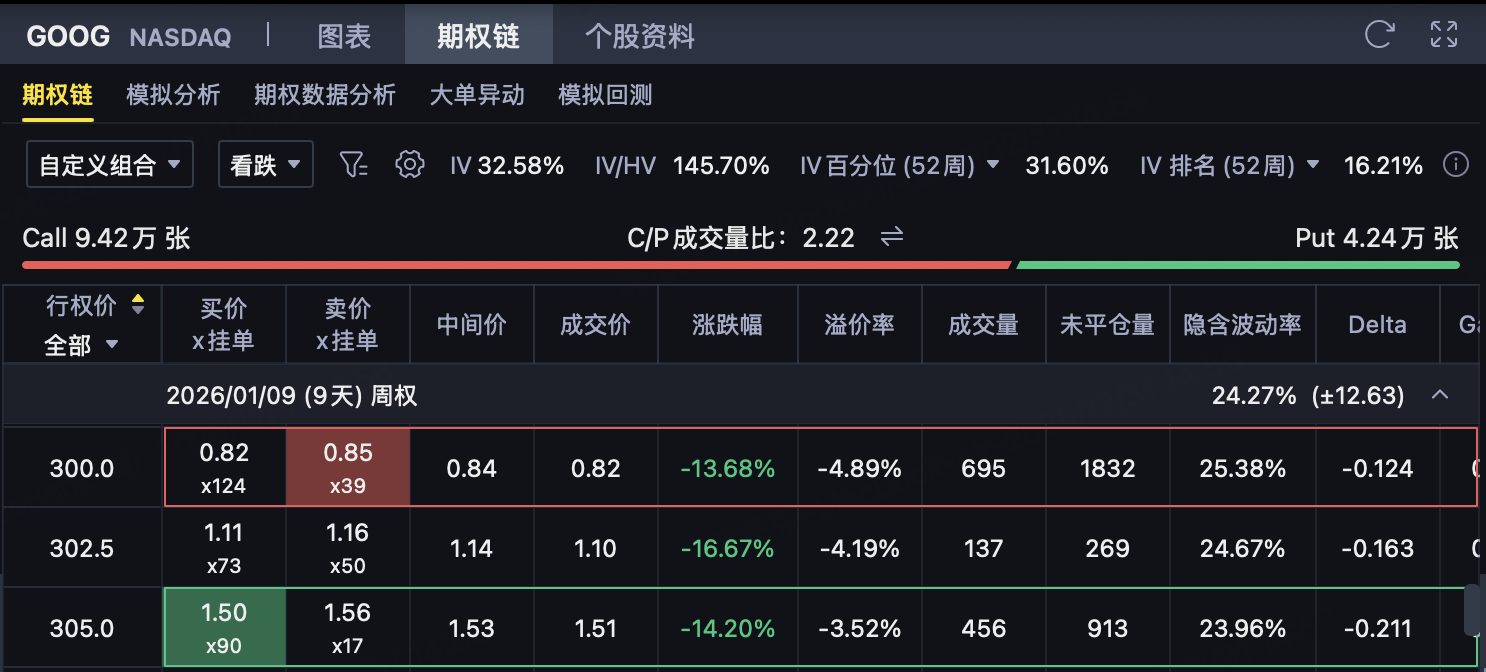
Put-side net income (per share):
= 1.51 − 0.82
= $0.69
This segment provides investors with premium gains when the GOOG expiration price does not significantly fall below $305.
(2) Call side (bearish spread, bearish)
Sell Call with lower strike price: Investors sell Call with strike price K ₃ = 322.5 and charge premium $1.92. This option is the core revenue source of the Call side.
Buy a Call with a higher strike price: Investors buy a Call with a strike price K ₄ = 327.5 and pay premium $0.90. This option is used to hedge risks and cap losses when GOOG rises sharply.
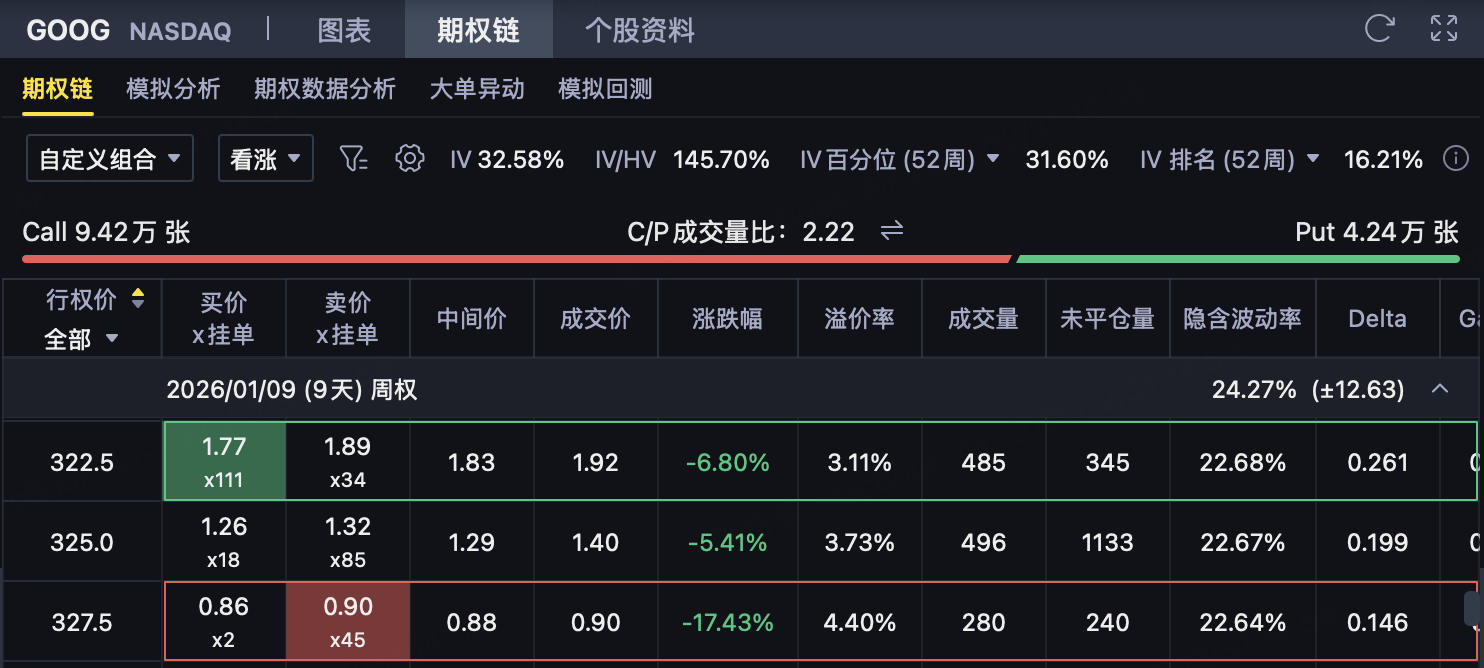
Call-side net income (per share):
= 1.92 − 0.90
= $1.02
This segment contributes returns to investors without the GOOG expiration price significantly breaking through $322.5.
Initial net income
The total net premium of the selling Iron Eagle strategy is the sum of the net income of the Put side and the Call side:
Net premium (per share):
= 0.69 + 1.02
= $1.71/share
Since 1 lot of options = 100 shares:
Total net income earned by investors when opening positions:
= 1.71 × 100
= $171/contract
This is also the maximum potential profit that this strategy can make.
3. Maximum profit
When the GOOG expiration price * * is between $305 and $322.5 (inclusive) * *:
Both options on the Put side and Call side are out of the money
All four options go to zero
Maximum profit (per share):
= Net premium received
= $1.71
Maximum profit (per contract):
= 1.71 × 100
= $171/contract
4. Maximum loss
The biggest loss of selling the Iron Eagle strategy occurs when the unilateral spread is fully triggered, that is, GOOG rises or falls sharply.
One-sided strike spread:
= $5 (305 − 300 or 327.5 − 322.5)
Maximum loss (per share):
= Strike spread − Net premium
= 5 − 1.71
= $3.29/share
Maximum loss (per contract):
= 3.29 × 100
= $329/contract
Occurrences include:
GOOG expiration price ≤ 300 USD (full in-price on the Put end)
Or GOOG expiration price ≥ 327.5 USD (full price on the Call side)
5. Break-even point
There are two break-even points in this selling Iron Eagle strategy:
Break-even point below:
= Put Sell Strike Price − Net premium
= 305 − 1.71
= $303.29
Above breakeven point:
= Call Sell Strike Price + Net premium
= 322.5 + 1.71
= $324.21
Maturity judgment rules:
Between $303.29 ~ $324.21 → Earnings for investors
= 303.29 or $324.21 → flat
≤ 303.29 or ≥ 324.21 USD → Investor loss
6. Risk and return characteristics
Maximum gain: $171/contract (limited)
Maximum loss: $329/contract (limited)
Profit-loss ratio: gain: loss ≈ 171: 329 ≈ 1: 1.9
Strategy features:
Focusing on the collection of time value and the decline of implied volatility
Bilateral risks are limited, and the maximum loss can be clarified when opening a position
The requirements for direction judgment are not high, but the requirements for price range and volatility judgment are higher
Applicable scenario: When investors expect that Google's stock price will most likely remain at$305 ~ $322.5It fluctuates within the range, and it is unlikely that there will be a trend breakthrough. At the same time, it is hoped that on the premise of clarifying the maximum risk and obtaining premium returns by selling the option portfolio, this selling iron eagle strategy has high practical reference value.
Disclaimer: Investing carries risk. This is not financial advice. The above content should not be regarded as an offer, recommendation, or solicitation on acquiring or disposing of any financial products, any associated discussions, comments, or posts by author or other users should not be considered as such either. It is solely for general information purpose only, which does not consider your own investment objectives, financial situations or needs. TTM assumes no responsibility or warranty for the accuracy and completeness of the information, investors should do their own research and may seek professional advice before investing.
