


Israel-Iran Conflict: Is the Risk Fully Priced In?
First, let's look at this week's large orders from the "Put Buyer."
Sell Puts:
-
$ORCL 20260306 116.0 PUT$ : 85,000 contracts sold to open
-
$SMH 20260306 350.0 PUT$ : 26,000 contracts sold to open
However, the play on AMD was different — Buy Puts:
-
$AMD 20260306 160.0 PUT$ : 42,000 contracts bought to open
Implied volatility (IV) on out-of-the-money semiconductor puts remains extremely elevated. This isn't due to bearish AI commentary, but rather the macroeconomic risk-off sentiment stemming from the Israel-Iran war, fueling expectations of a broad market pullback.
It's crucial to note that the outbreak of the war hasn't fully released the risk. At Monday's market open, the indices didn't drop to any of the levels anticipated by the bearish puts. This suggests a significant amount of capital already knew the conflict was imminent. The unknown, unforeseen negative catalysts are what remain truly dangerous.
$SPY$
The first pullback target for SPY was 670, the second was 650. Neither was hit.
I understand 670 was the level priced for the Israel-Iran war. What would trigger a move to 650 is unclear. The point is, even with the war underway, the risk hasn't fully materialized.
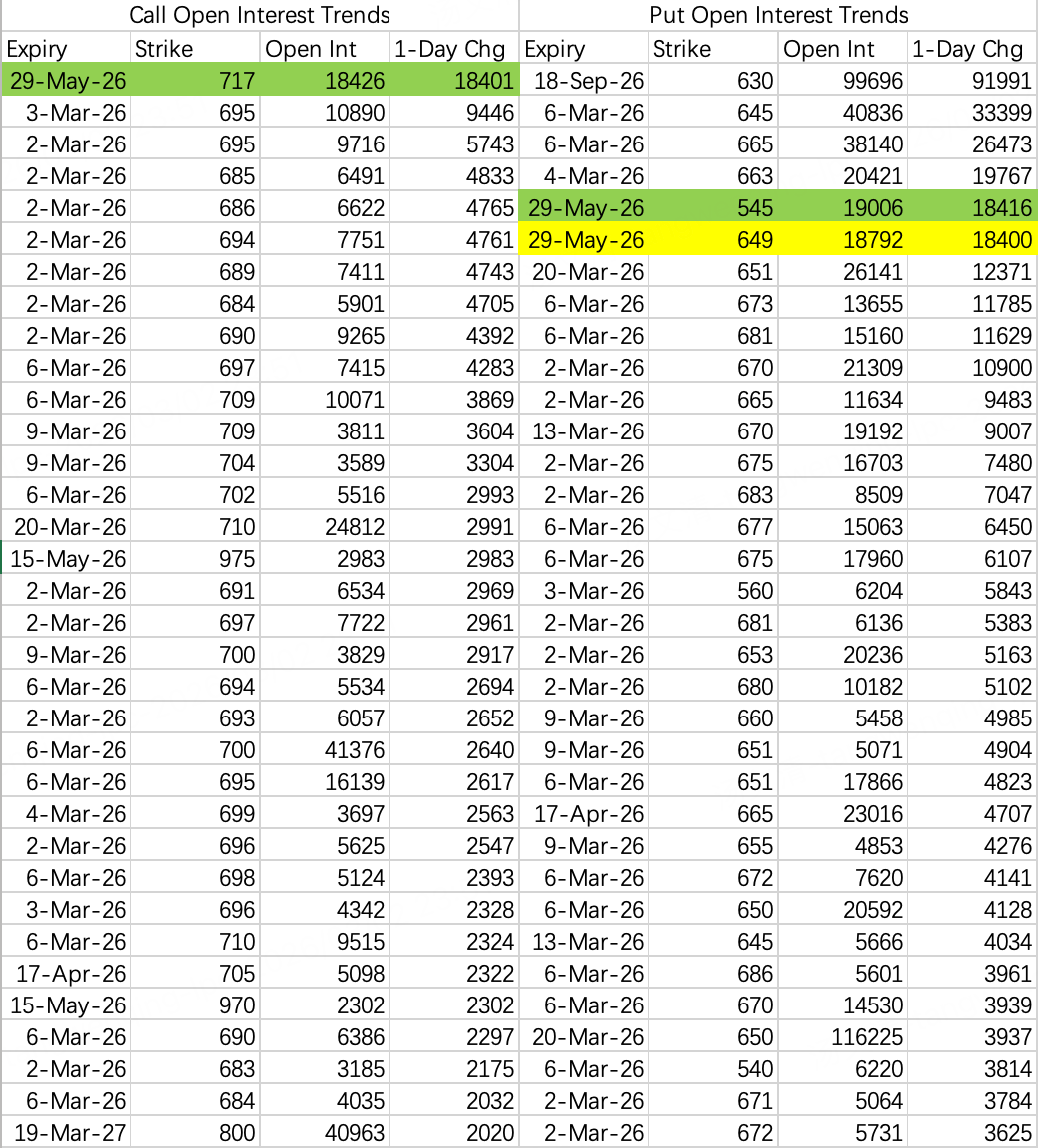
However, a drop to 650 seems less certain than a drop to 670. A very cost-effective hedge trade appeared on SPY: Sell 717 Call / Buy 649 Put / Sell 545 Put. This collar strategy costs almost nothing. Typically, when such zero-cost hedges appear, it implies a low probability of a sharp crash.

$UVIX$
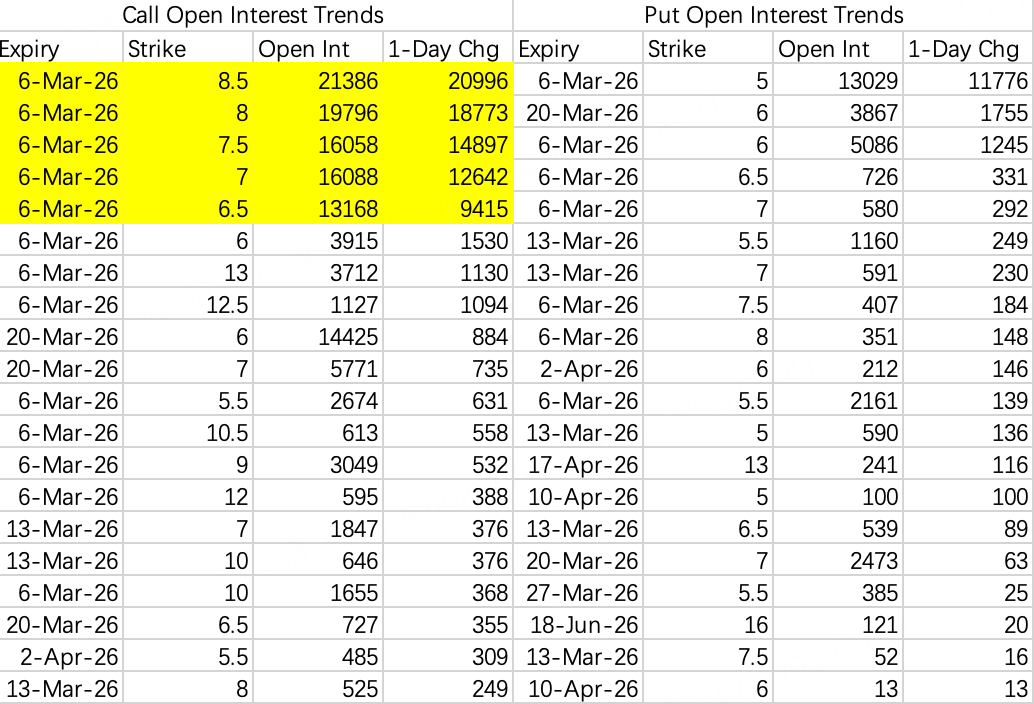
It's also possible the 650 target was a direct bet on the Israel-Iran war. We saw a flurry of buying in weekly call options on the 2x VIX futures ETF (UVIX), with strikes ranging from 6 to 8.5. These were 0DTE (zero days to expiration) options. Without a market crash on Monday, these calls expire worthless.
And indeed, after the market stabilized on Monday, those large orders, like the $UVIX 20260306 8.5 CALL$ , were all closed.
$NVDA$
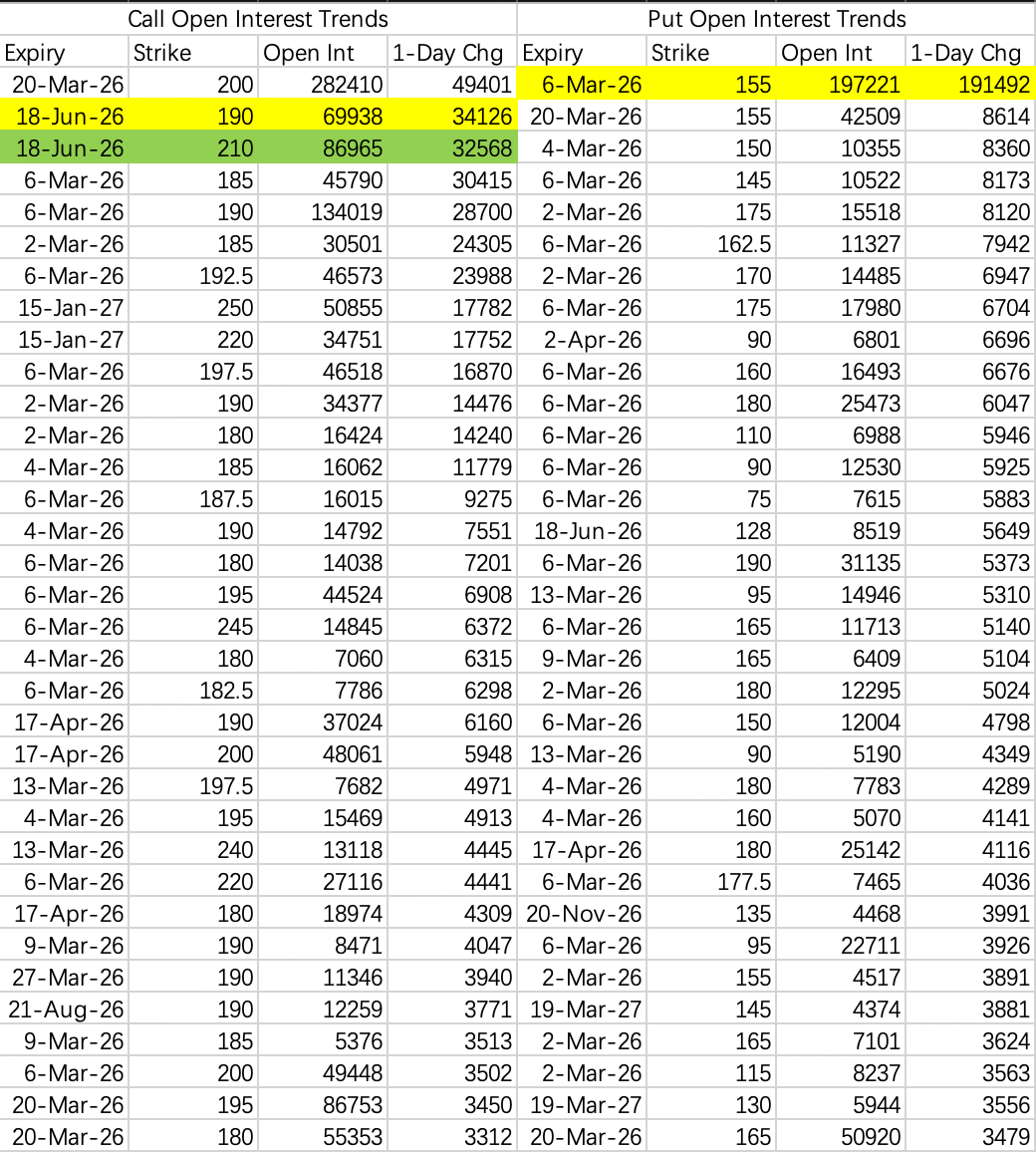
Like SPY, NVDA has two potential retracement levels: 170 and 155. Notably, 155,000 contracts of the weekly 155 put $NVDA 20260306 155.0 PUT$ were bought to open.
On the call side, medium-term bullish targets are seen in the 190 $NVDA 20260618 190.0 CALL$ to 210 $NVDA 20260618 210.0 CALL$ range. However, this month is clearly not suitable for bullish call spreads.
For this week, selling calls is more appropriate. Institutional call spreads are aggressive this week, selling the 185 call $NVDA 20260306 185.0 CALL$ and hedging with the 192.5 call $NVDA 20260306 192.5 CALL$ . I believe selling calls above 190, like the 190 or 195 strike, would be safer.
With 190,000 contracts of the 155 put in play, the lower bound of this week's trading range is difficult to predict.
$NFLX$
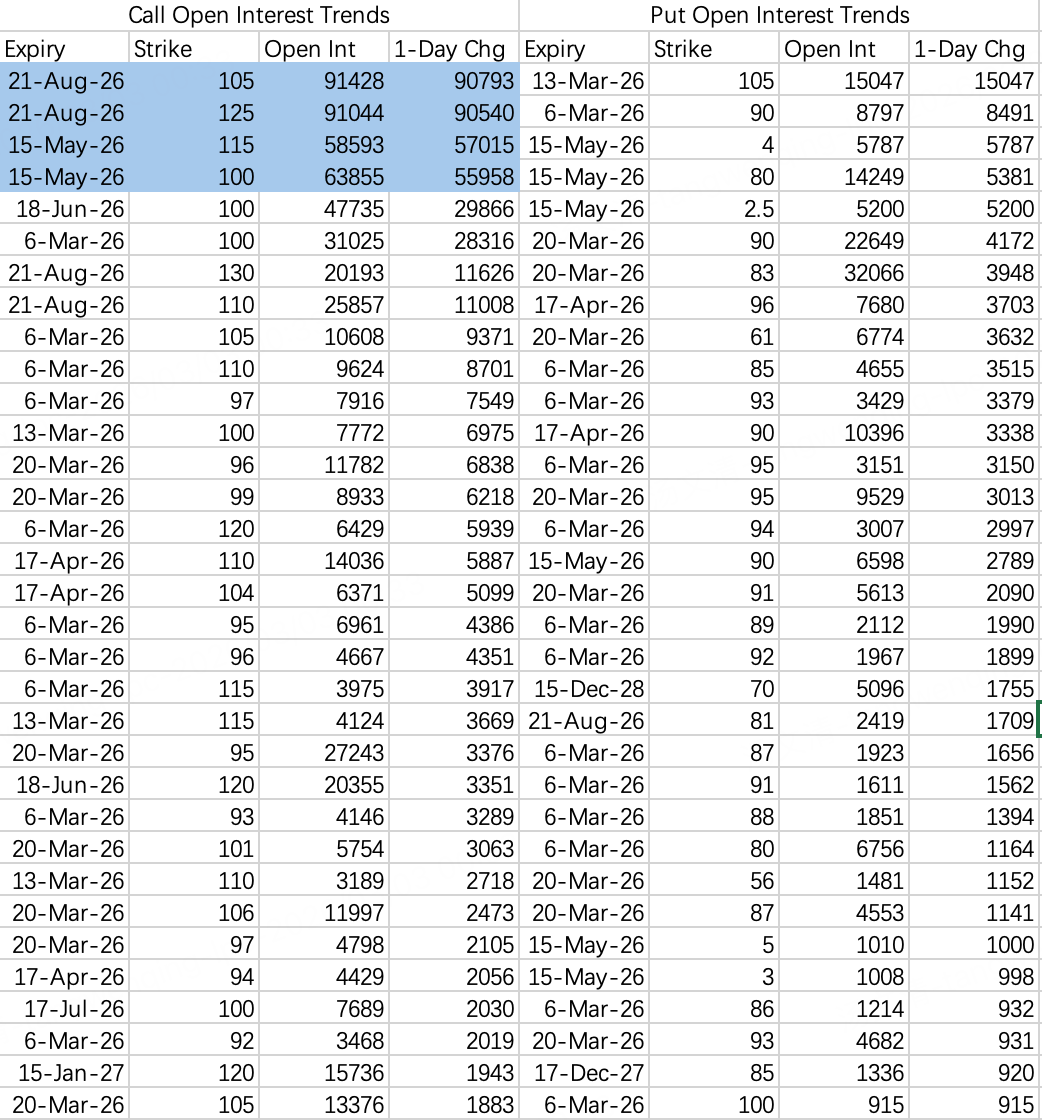
Large bullish call spreads were opened:
-
$NFLX 20260821 105.0 CALL$ : 90,000 contracts
-
$NFLX 20260821 125.0 CALL$ : 90,000 contracts

And another set:
-
$NFLX 20260515 100.0 CALL$ : 55,000 contracts
-
$NFLX 20260515 115.0 CALL$ : 57,000 contracts

The price is expected to stay above 90 and below 110 until the next earnings report.
$IGV$
The software ETF (IGV) has temporarily stabilized, suggesting the Q1 sell-off in software stocks might be pausing. A large "short strangle" strategy was employed: Sell 85 Call $IGV 20260515 85.0 CALL$ / Sell 65 Put $IGV 20260515 65.0 PUT$ / Buy 60 Put $IGV 20260515 60.0 PUT$ .
It's unclear if this is paired with long stock positions, as selling such a low-strike call carries significant short-squeeze risk. However, it also indicates institutions aren't genuinely bullish on software. With rapid AI development, another explosive negative catalyst is not a low-probability event.
IGV's holdings are complex. Some constituents are suitable for selling puts (e.g., top holding Microsoft), while others, like ADBE, face significant AI disruption risk and could even be candidates for long-term shorts.

$XLE$
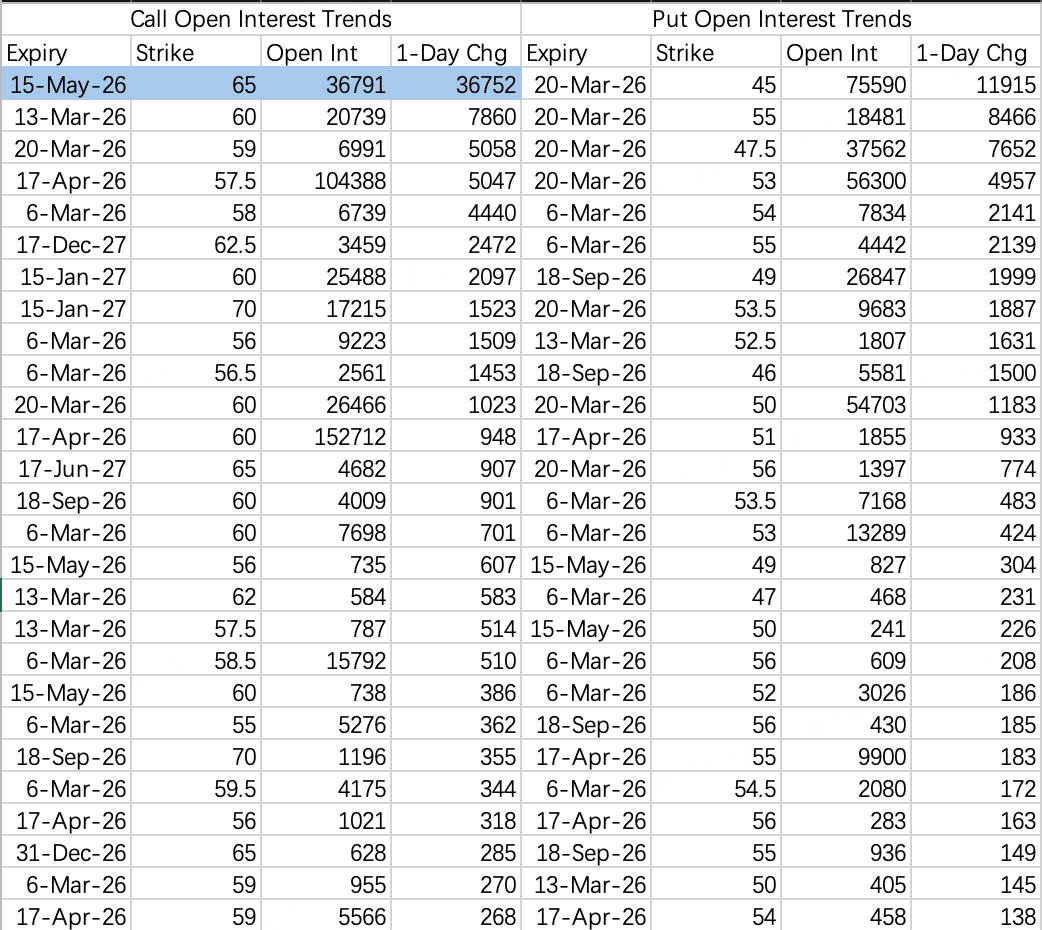
There's no need to chase crude oil here. XLE is likely to trade in a 50-60 range.
A large order for the 65 call $XLE 20260515 65.0 CALL$ (36,000 contracts) was closed at Monday's open, signaling that the recent sharp rally may have paused.
Disclaimer: Investing carries risk. This is not financial advice. The above content should not be regarded as an offer, recommendation, or solicitation on acquiring or disposing of any financial products, any associated discussions, comments, or posts by author or other users should not be considered as such either. It is solely for general information purpose only, which does not consider your own investment objectives, financial situations or needs. TTM assumes no responsibility or warranty for the accuracy and completeness of the information, investors should do their own research and may seek professional advice before investing.
