


There is pressure above Nvidia, and this strategy is more stable
Recently,$NVIDIA (NVDA) $The main line of fundamentals has not weakened significantly. On the one hand, Reuters reports that Thinking Machines Lab has secured a large supply agreement for Nvidia's multi-generation AI chips, reflecting that the demand for high-end computing power is still strong; On the other hand, the market is also continuously paying attention to the new generation of inference chips to be displayed by Nvidia and the catalysis related to GTC conference, indicating that the main line of AI itself still has support.
However, from the perspective of stock price, the market's pricing of Nvidia is no longer as simple as "whether the demand is strong or not". Reuters pointed out after the financial report that although the company's performance and guidance are still strong, investors are beginning to pay more attention to the return cycle of huge AI investment, and the company's practice of continuing to invest more resources in ecological expansion instead of directly giving back to shareholders; At the same time, Broadcom's positive outlook on AI chip sales has also made the market reevaluate Nvidia's competitive landscape in AI infrastructure. In other words, Nvidia's long-term logic is still there, but it continues to attack unilaterally in the short term, which requires stronger new catalysis.
In this context, if it is judged that it is difficult to effectively break through the pressure range above $190-$192.5 before NVDA expires, you can consider building a bear market bullish spread strategy of 190/192.5, and strive for profits by collecting premium while controlling upside risks.
NVDA Bear Call Spread Strategy
Strategic Structure
Investors in$NVIDIA (NVDA) $Build a Bear Call Spread strategy on options. This strategy is a bearish/shock strategy that collects premium, limited income and limited risk, and is suitable for judging the situation that NVDA is difficult to effectively break through the upper pressure area, maintain shock or drop slightly before expiration.
1 ️ ⃣ Sell Lower Strike Price Call (Main Source of Revenue)
Sell 1 Call with strike price K₁ = $190
premium charged = $3.48/share (at mid-parity)

The Call is closer to the current price and is a major source of revenue for Strategy premium. As long as the expiration price is ≤ $190, the option lapses and the investor retains all premium rights.
2 ️ ⃣ Buy the higher strike price Call (control upside risk)
Buy 1 Call with strike price K₂ = $192.5
Paid premium = $2.59/share (at mid-parity)
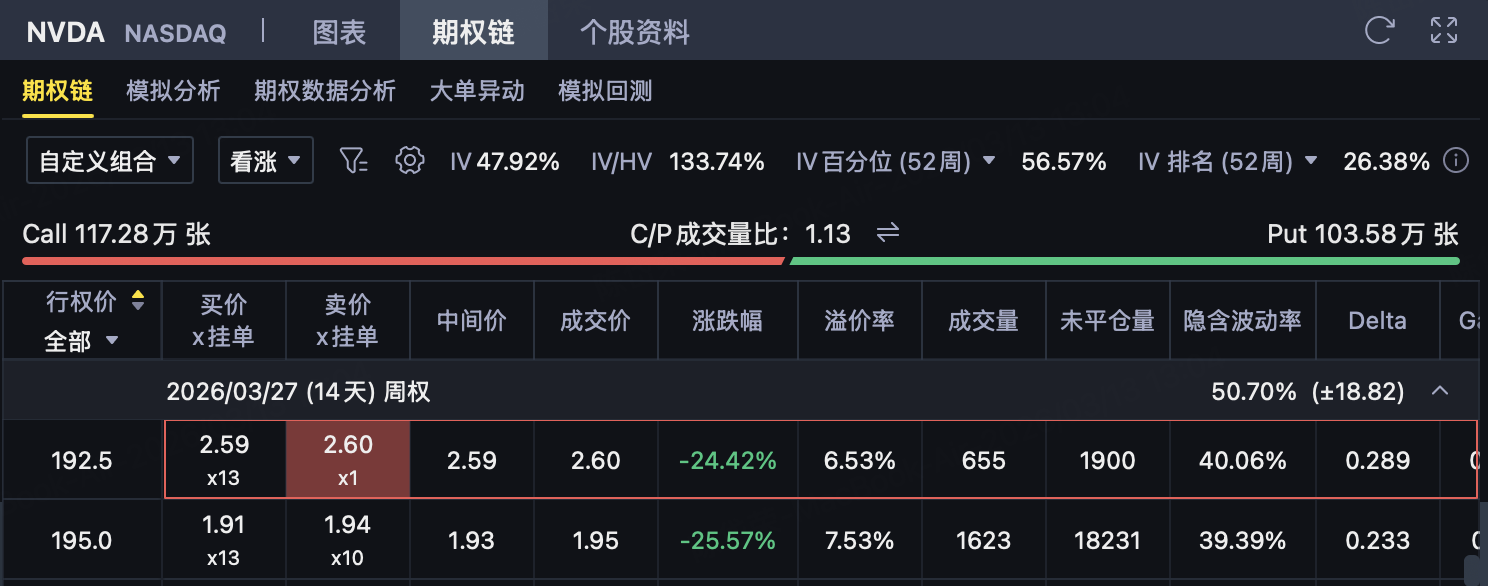
This Call is used to limit the risk when NVDA rises sharply and avoid the risk of unlimited losses caused by naked selling calls.
3 ️ ⃣ Call-end net income (per share)
Net premium income was:
3.48 − 2.59= $0.89/share
This is the greatest available gain from the strategy.
Maximum Profit
When the NVDA expiry price is ≤ $190:
Both calls are out of the money
All options lapse
Investors Retain All Net premium
Maximum Profit (Per Share) = $0.89
Per contract (100 shares) = $89
Occurrence conditions:
Price to maturity ≤ $190
Maximum loss
When the NVDA expiry price is ≥ $192.5:
Both calls are in-price
The strike spread is fully locked in
Calculation:
Strike spread:
192.5 − 190= $2.5
Maximum loss (per share):
Strike Spread − Net premium
=2.5 − 0.89= $1.61/share
Maximum loss per contract = $161
Occurrence conditions:
Price to maturity ≥ $192.5
BREAK-EVEN POINT
Formula:
Sell Call Strike Price + Net premium
=190+0.89= $190.89
Maturity judgment:
Price ≤190.89 → Earnings
Price =190.89 → No Profit or Loss
Price ≥190.89 → Loss
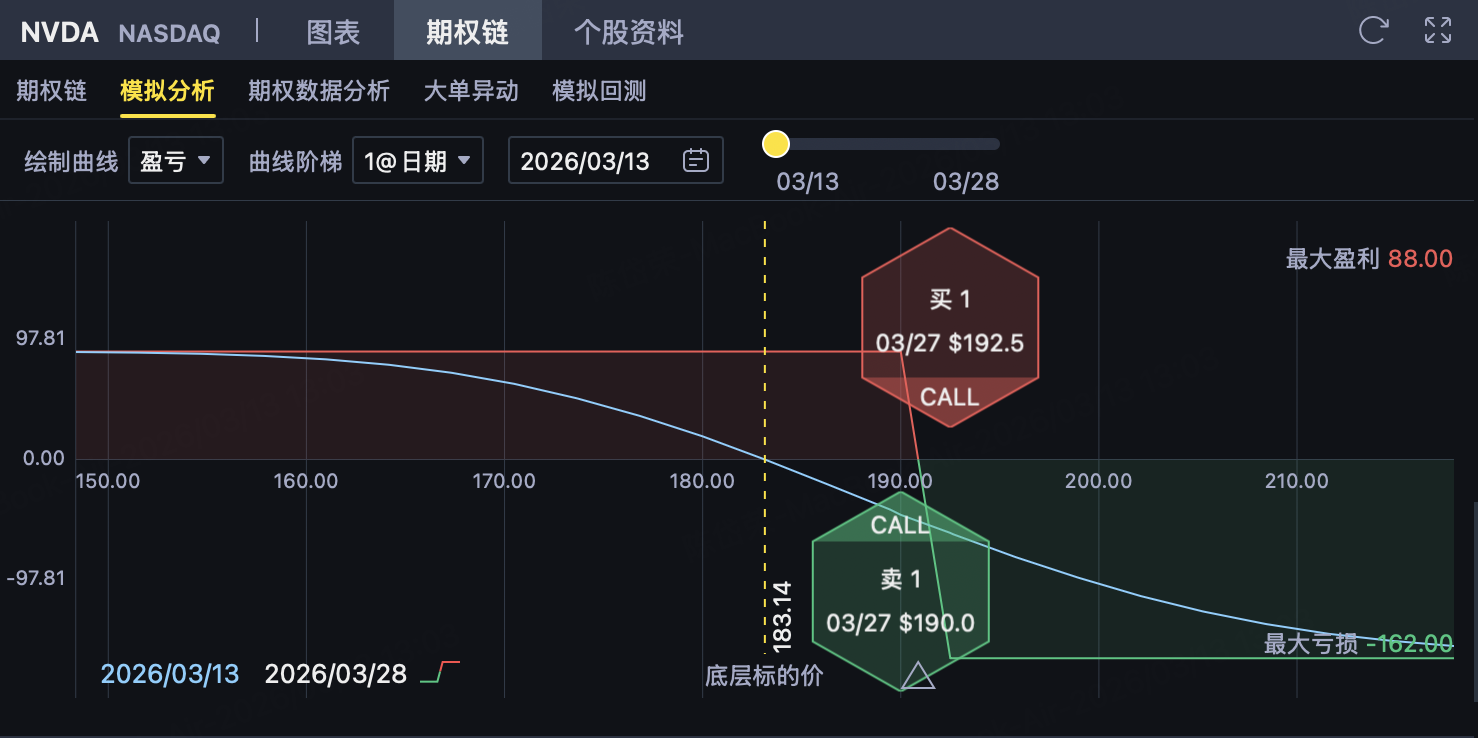
V. Strategy characteristics and applicable scenarios
Strategic characteristics
Clear bearish/shock-looking strategy
Collect premium Structure, Time Value Is Good For Investors
The maximum gain and maximum loss are determined when the position is opened
Upside risk is capped compared to naked selling Call
Risk-to-return ratio is approximately 1:0.55 (risk 1.61, return 0.89)
Applicable Scenario
When investors judge:
NVDA pressured significantly in the 190 – 192.5 range
Low probability of an effective break of 192.5 in the short term
Although the demand for AI is still strong, the market's repricing of valuation, return on capital investment and competitive landscape may limit the stock price to continue to rise rapidly in the short term.
Or the implied volatility is at a medium to high level, which is suitable for building a closing premium structure
The structure is essentially:
"Use the risk of $1.61 to gain the income of $0.89".
The winning rate of the strategy depends on the judgment that "the price holds the pressure above 190, at least not effectively breaking through 190.89"; If the subsequent GTC conference releases unexpected catalysis, or the AI demand logic once again promotes funds to concentrate on pursuing the leader, NVDA will quickly break the pressure range, and the portfolio loss will expand, but the maximum loss has been capped at the time of opening a position.
Disclaimer: Investing carries risk. This is not financial advice. The above content should not be regarded as an offer, recommendation, or solicitation on acquiring or disposing of any financial products, any associated discussions, comments, or posts by author or other users should not be considered as such either. It is solely for general information purpose only, which does not consider your own investment objectives, financial situations or needs. TTM assumes no responsibility or warranty for the accuracy and completeness of the information, investors should do their own research and may seek professional advice before investing.
Great article, would you like to share it?